








Website Maintenance vs Web Development: What’s the Difference and When Do You Need Each?
Last updated: April 2026 · 11-minute read · By GA Digital Solutions, Hyderabad
One of the most common points of confusion we encounter with business owners across India is the difference between website maintenance and web development. The two are often spoken about interchangeably — or worse, businesses invest in one when they actually need the other.
The confusion is understandable. Both involve someone working on your website. Both are done by people who understand technology. Both cost money. And both are necessary at different times for different reasons.
But they are fundamentally different in purpose, scope, cost structure, and what they produce. Getting this distinction clear is important for making good decisions about your website budget and for knowing what to ask for when something is wrong.
This guide explains the difference plainly, compares them across every meaningful dimension, and helps you identify which one your business needs — right now.
The One-Line Definitions
| Web Development | The process of designing, building, or significantly rebuilding a website. It has a defined start point, a deliverable, and an end point. |
| Website Maintenance | The ongoing process of keeping an existing website secure, updated, fast, and functioning correctly. It has no end point — it continues for as long as the website is live. |
The Right Analogy: Building vs. Maintaining a Property
The clearest way to understand the difference is through an analogy most people intuitively grasp.
Imagine a commercial property — a shop, an office, a clinic. Constructing that property is a one-time project. Architects design it, contractors build it, and at the end of the process you have a finished building. That is web development.
But the building does not maintain itself. The roof needs waterproofing. The electrical systems need inspection. The plumbing needs servicing. The premises need cleaning. Locks need replacing. Fire safety equipment needs annual certification. None of this is “building a new property” — it is maintaining the existing one. That is website maintenance.
A building that is well-constructed but never maintained will deteriorate. A website that is well-built but never maintained will do exactly the same.
The key insight: building quality and maintenance are separate variables. A poorly built website maintained consistently will outperform a beautifully built website that is never maintained. Both matter.
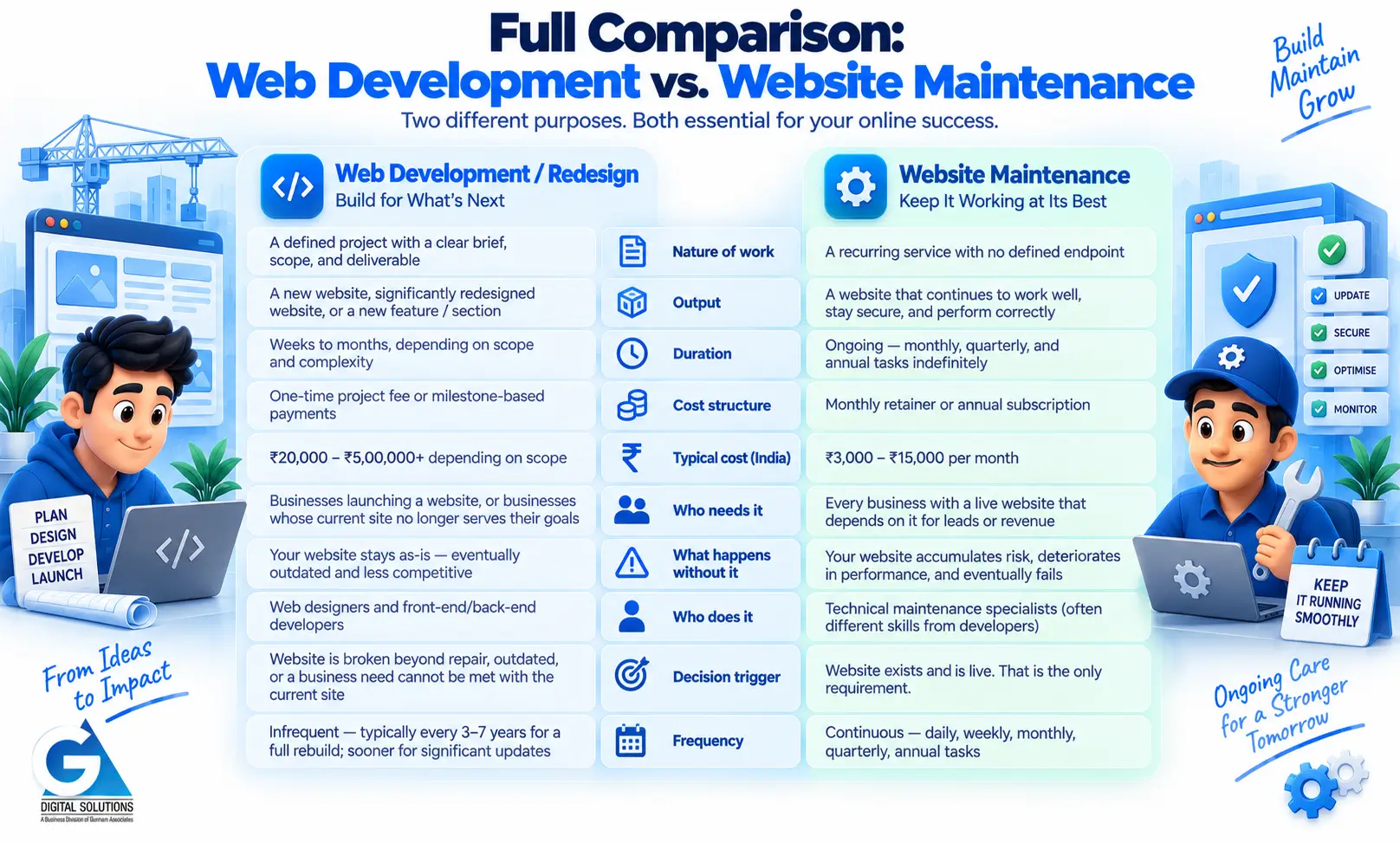
Full Comparison: Web Development vs. Website Maintenance
Here is a detailed side-by-side comparison across every dimension that matters for a business owner making decisions about their website.
| Dimension | Web Development / Redesign | Website Maintenance |
|---|---|---|
| Nature of work | A defined project with a clear brief, scope, and deliverable | A recurring service with no defined endpoint |
| Output | A new website, significantly redesigned website, or a new feature / section | A website that continues to work well, stay secure, and perform correctly |
| Duration | Weeks to months, depending on scope and complexity | Ongoing — monthly, quarterly, and annual tasks indefinitely |
| Cost structure | One-time project fee or milestone-based payments | Monthly retainer or annual subscription |
| Typical cost (India) | ₹20,000 – ₹5,00,000+ depending on scope | ₹3,000 – ₹15,000 per month |
| Who needs it | Businesses launching a website, or businesses whose current site no longer serves their goals | Every business with a live website that depends on it for leads or revenue |
| What happens without it | Your website stays as-is — eventually outdated and less competitive | Your website accumulates risk, deteriorates in performance, and eventually fails |
| Who does it | Web designers and front-end/back-end developers | Technical maintenance specialists (often different skills from developers) |
| Decision trigger | Website is broken beyond repair, outdated, or a business need cannot be met with the current site | Website exists and is live. That is the only requirement. |
| Frequency | Infrequent — typically every 3–7 years for a full rebuild; sooner for significant updates | Continuous — daily, weekly, monthly, quarterly, annual tasks |
What Web Development Covers
Web development is the right investment when you are building something new or changing something significantly. Here is what typically falls under development work.
Building a New Website from Scratch
If your business has no website, or if you are launching a new venture, you need web development. This includes everything from domain strategy and information architecture through to design, coding, content integration, and launch.
Website Redesign
If your existing website no longer represents your brand, does not reflect your current services, or fails to perform adequately for modern users and search engines, a redesign project is appropriate. This is not maintenance — it is a new build that replaces or substantially overhauls the existing site.
Adding a New Major Feature or Section
Adding an e-commerce capability to a brochure website, building a client portal, integrating a booking system, or creating a new service section are all development tasks. They require design, coding, and testing work that goes beyond the scope of routine maintenance.
Custom Functionality Development
Custom calculators, interactive tools, API integrations with third-party platforms, membership systems, and any bespoke functionality that does not exist as a standard plugin or template falls under web development.
Web development produces a deliverable. At the end of a development project, you have something that did not exist before — or something that has been substantially changed. That is how you know you are in development territory.
What Website Maintenance Covers
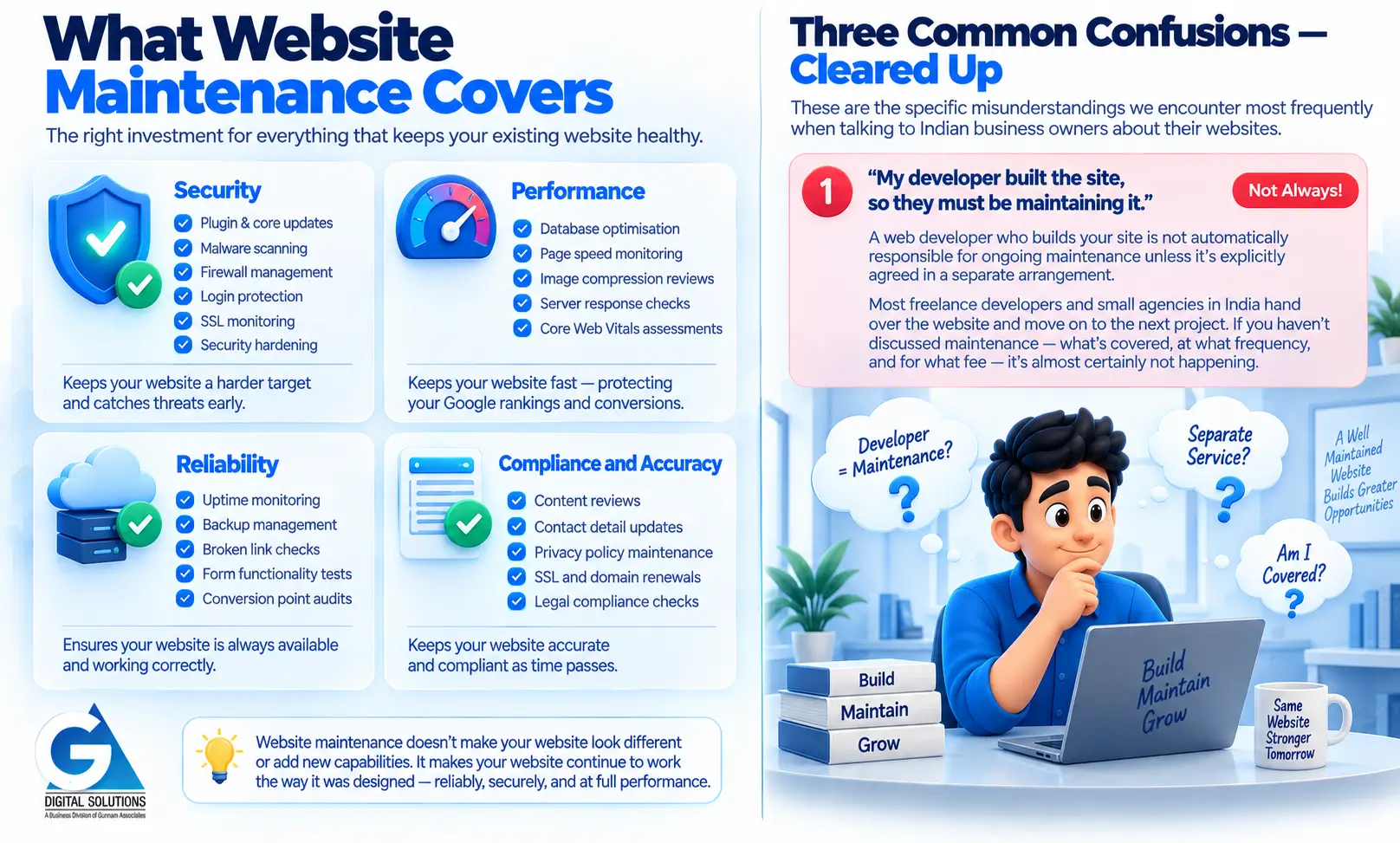
Website maintenance is the right investment for everything that keeps your existing website healthy. It does not build new things — it protects and preserves what already exists.
Security
Plugin updates, core platform updates, malware scanning, firewall management, login protection, SSL certificate monitoring, and security hardening. Maintenance keeps your website a harder target and catches threats before they reach your visitors.
Performance
Database optimisation, page speed monitoring, image compression reviews, server response time checks, and Core Web Vitals assessments. Maintenance keeps your website fast — which protects both your Google rankings and your conversion rate.
Reliability
Uptime monitoring, backup management, broken link checks, form functionality tests, and conversion point audits. Maintenance ensures your website is always available and that every path a visitor can take to become a lead is working correctly.
Compliance and Accuracy
Content reviews, contact detail updates, privacy policy maintenance, SSL and domain renewal management, and legal compliance checks. Maintenance ensures your website remains accurate and compliant as time passes.
Website maintenance does not make your website look different or add new capabilities. It makes your website continue to work the way it was designed to work — reliably, securely, and at full performance.
Three Common Confusions — Cleared Up
These are the specific misunderstandings we encounter most frequently when talking to Indian business owners about their websites.
Confusion 1: “My developer built the site, so they must be maintaining it”
This is the most dangerous assumption in website management. A web developer who builds your site is not automatically responsible for ongoing maintenance unless that has been explicitly agreed and is covered in a separate maintenance arrangement.
Most freelance web developers and small agencies in India hand over a completed website and then move on to the next project. Maintenance is a separate, ongoing commitment that needs to be separately contracted and separately paid for.
If you have not explicitly discussed maintenance with your developer — including what is covered, at what frequency, and for what fee — it is almost certainly not happening.
Confusion 2: “I updated some content last month, so my website is maintained”
Adding a blog post, updating a phone number, or uploading a new image is content management — not website maintenance. These tasks keep your content current, which is valuable, but they do not address security vulnerabilities, performance degradation, backup integrity, or any of the technical factors that make up a proper maintenance programme.
A website can have perfectly current content and simultaneously be running twelve outdated plugins, have no recent backup, and be actively serving malware to visitors. Content management and website maintenance are parallel responsibilities, not interchangeable ones.
Confusion 3: “My website seems fine, so it must be fine”
This confusion is addressed in depth in our guide on what happens if you don't maintain your website. The short version: most website maintenance failures are invisible to the business owner and to ordinary visitors until they become serious.
A website can appear to load and function normally while running known security vulnerabilities, having no backup, serving malware to visitors, or having a broken contact form that is silently discarding enquiries. The absence of visible problems is not evidence of good maintenance.
When You Need Development, When You Need Maintenance, and When You Need Both
Here are twelve real business situations and what each one actually calls for.
- “We have no website and need to launch one.”
You need: Development — New Website Build
A web development project to design, build, and launch your website. Once the site is live, maintenance begins. - “Our website is 5 years old and looks outdated.”
You need: Development — Website Redesign
A redesign project to update the visual design, UX, and possibly the technical platform. Maintenance continues or begins fresh after the redesign launches. - “Our contact form stopped working.”
You need: Maintenance — Maintenance Fix
Diagnosing and resolving a broken form is a maintenance task. It should be caught and fixed within days in a properly maintained website — or within the monthly check cycle. - “We want to add an online store to our existing website.”
You need: Development — Development Project
Adding e-commerce capability is a development task. Once built, the new store will require ongoing maintenance — especially for payment gateway uptime and product data. - “Our website got hacked.”
You need: Maintenance — Emergency Maintenance
Malware removal, security hardening, and vulnerability patching are maintenance tasks. Once recovered, a proper ongoing maintenance plan prevents recurrence. - “Our Google rankings have been dropping for months.”
You need: Both — Maintenance + Possible Development
Technical SEO issues (maintenance) are usually the cause. Resolving crawl errors, speed issues, and Core Web Vitals is maintenance work. If the website needs structural changes to fix the issue, some development may be required. - “We are launching a new service and need a new page.”
You need: Development — Minor Development
Adding a new page or section is a small development task. It is not maintenance. Once added, the new page falls under the ongoing maintenance programme. - “Our website is very slow and taking too long to load.”
You need: Maintenance — Performance Maintenance
Speed optimisation — database cleanup, image compression, caching, server configuration — is a maintenance task. If the site’s architecture is fundamentally inefficient, a development intervention may also be needed. - “We want to rebrand and need a new logo and visual identity on our website.”
You need: Development — Development Project
Implementing a rebrand across a website is a design and development task. It requires creative and technical work beyond the scope of maintenance. - “We have not updated our plugins in 8 months.”
You need: Maintenance — Catch-up Maintenance
Applying overdue updates — carefully and in a staged environment — is maintenance. This is urgent: 8 months of unreviewed updates represents significant security exposure.
How to Budget for Both
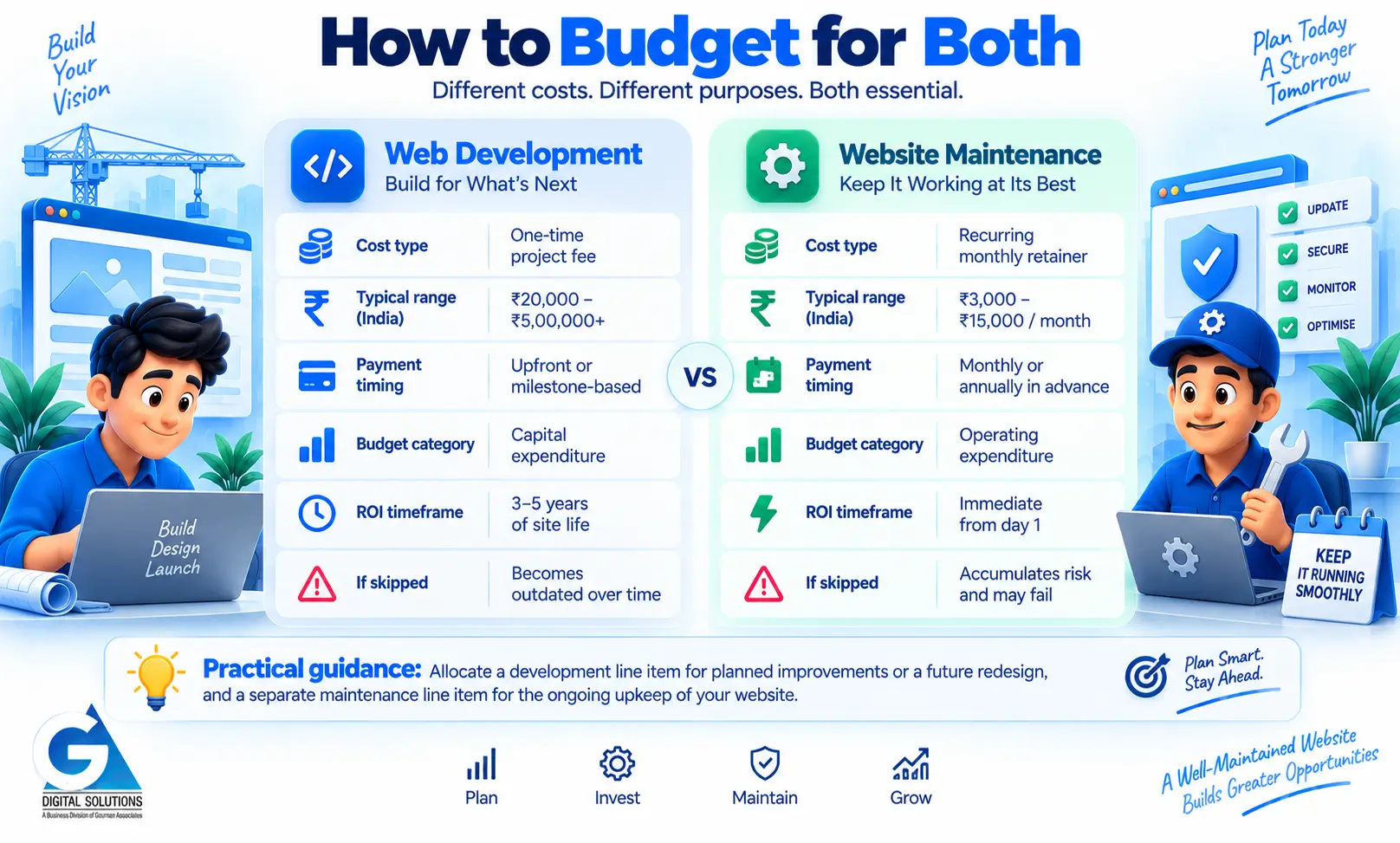
Web development and website maintenance have very different cost structures. Understanding this helps you plan your website budget correctly.
| Dimension | Web Development | Website Maintenance |
|---|---|---|
| Cost type | One-time project fee | Recurring monthly retainer |
| Typical range (India) | ₹20,000 – ₹5,00,000+ | ₹3,000 – ₹15,000 / month |
| Payment timing | Upfront or milestone-based | Monthly or annually in advance |
| Budget category | Capital expenditure (one-off investment) | Operating expenditure (ongoing cost) |
| ROI timeframe | Measured over 3–5 years of site life | Immediate — prevents costly incidents from day 1 |
| What happens if skipped | Website becomes outdated and less competitive over time | Website accumulates risk and may fail catastrophically |
Practical guidance: In your annual website budget, allocate a development line item for planned improvements or a future redesign, and a separate maintenance line item for the ongoing cost of keeping your current site healthy. These are not interchangeable. Both are necessary.
→ Not sure what your website currently needs? Get a Free 20-Point Website Health Audit
We assess your website against 20 key indicators and deliver a plain-language report within 2 business days. No cost, no obligation.
Frequently Asked Questions
Yes — and many full-service agencies like GA Digital Solutions offer both. However, the skills required are partially different. Front-end web development requires design and coding expertise. Website maintenance requires technical operational knowledge, security specialisation, and systematic process management. When evaluating a provider for both, ask specifically about their maintenance processes and whether they have dedicated maintenance staff rather than just developers who also handle maintenance as an afterthought.
Yes, with some modifications. Website builders like Wix and Squarespace handle core platform updates and server management automatically, which reduces the technical maintenance burden. However, your content still needs reviewing, your domain still needs renewing, your forms still need testing, and your performance and analytics still need monitoring. The distinction between “adding a new page or feature” (development) and “keeping the existing site running well” (maintenance) applies to any website platform.
Yes. Your current website is still live, still representing your business, still handling visitor data, and still affecting your search rankings until the moment the new site goes live. Neglecting it during the redesign period is a real risk. If the current site is hacked while the redesign is in progress, it may affect the new site’s launch timeline, hosting environment, or data. Maintenance should continue until the new site replaces the old one.
Possibly — but not necessarily. No maintenance programme can guarantee zero security incidents. What maintenance provides is dramatically reduced risk. If your provider was applying updates, running security scans, and following a proper process, a hack may still occur through a zero-day vulnerability (one that was not yet publicly known or patched). However, if the hack occurred through an outdated plugin that had a known patch available, that is a maintenance failure worth questioning.
A redesign is warranted when: (a) the website’s design is genuinely outdated and is affecting your brand credibility; (b) the website cannot meet a business need without structural changes; (c) the technical platform is outdated to the point where maintenance has become inefficient or unsafe; or (d) your business has changed significantly and the website no longer reflects what you do. Improved maintenance is the right answer when: the website is fundamentally sound but has been neglected, and restoring it to good health will solve the problems you are experiencing.
Summary
Web development and website maintenance are distinct, complementary disciplines. Development builds or significantly changes your website. Maintenance keeps what you have built secure, healthy, and working correctly.
You need both. Development happens periodically — when you launch, when you redesign, when you add significant new features. Maintenance happens continuously — from the day your website goes live until the day it is replaced.
The most common and costly mistake is treating them as interchangeable: assuming that because a developer built the site, it is being maintained; or assuming that because the site “looks fine,” it is fine. Neither assumption is reliable.
If you are not certain whether your website is currently being maintained — or what that maintenance covers — the right first step is a professional audit. GA Digital Solutions’ free 20-point website health audit gives you an honest, plain-language picture of where things stand.
→ Get My Free Website Health Audit — Understand Exactly What Your Site Needs
Continue Reading
Explore the full GA Digital Solutions website maintenance guide series.
Core Guides
- Website Maintenance Services: The Complete Guide for Indian Businesses (2026)
- What Is Website Maintenance? Everything Business Owners Need to Know
- Why Website Maintenance Is Important: 10 Risks of Neglecting Your Site
- How Often Should You Update Your Website?
- The Complete Website Maintenance Checklist
- What Happens If You Don’t Maintain Your Website?
Evaluate Your Options
GA Digital Solutions is a full-service digital agency based in Hyderabad, India. We provide website maintenance, design and development, SEO, performance marketing, and lead management services to businesses across India.
Page last reviewed: April 2026
