








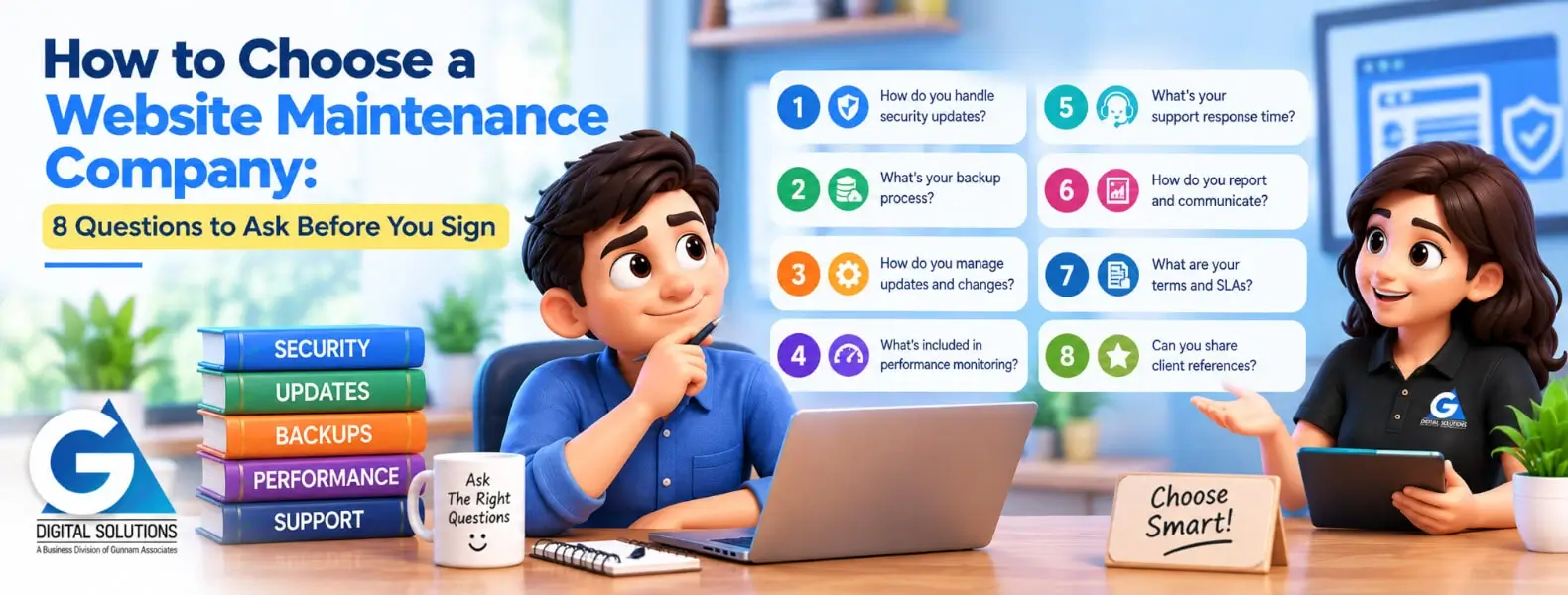
How to Choose a Website Maintenance Company: 8 Questions to Ask Before You Sign
Last updated: May 2026 · 13-minute read · By GA Digital Solutions, Hyderabad
Choosing a website maintenance company is not the same as choosing a web designer. The skills are different, the relationship is ongoing rather than project-based, and the consequences of getting it wrong are not a website you dislike — they are a security incident, a prolonged outage, or data that cannot be recovered.
The Indian market has a wide range of providers, from individual freelancers to full-service agencies, with a wide range of quality, processes, and transparency. Price alone tells you very little. A ₹1,500/month plan and a ₹7,000/month plan can look identical on the surface and be radically different in practice.
The best way to assess a provider is to ask specific, direct questions before you engage — and to know what a strong answer looks like, and what a weak answer reveals.
This guide gives you eight questions to ask any website maintenance company in India, with a clear breakdown of what each answer tells you about the quality of the service you will actually receive.
Why the Right Questions Matter More Than the Right Price
Most business owners evaluating maintenance providers focus primarily on price. Price matters — but it is a poor proxy for quality in this industry, because there is no standard scope of service that “website maintenance” universally means.
Two providers quoting the same monthly fee may include very different things. One may apply updates directly to your live site without testing. The other may use a full staging environment. One may store backups on the same server as your website. The other may store them in a secure, off-site location. One may include malware removal. The other may charge ₹30,000+ as an emergency fee.
Questions reveal processes. And processes are what actually determine whether your website is protected or not.
A provider who cannot or will not answer these questions clearly — or who responds with vague assurances — is telling you something important about the transparency of their service.
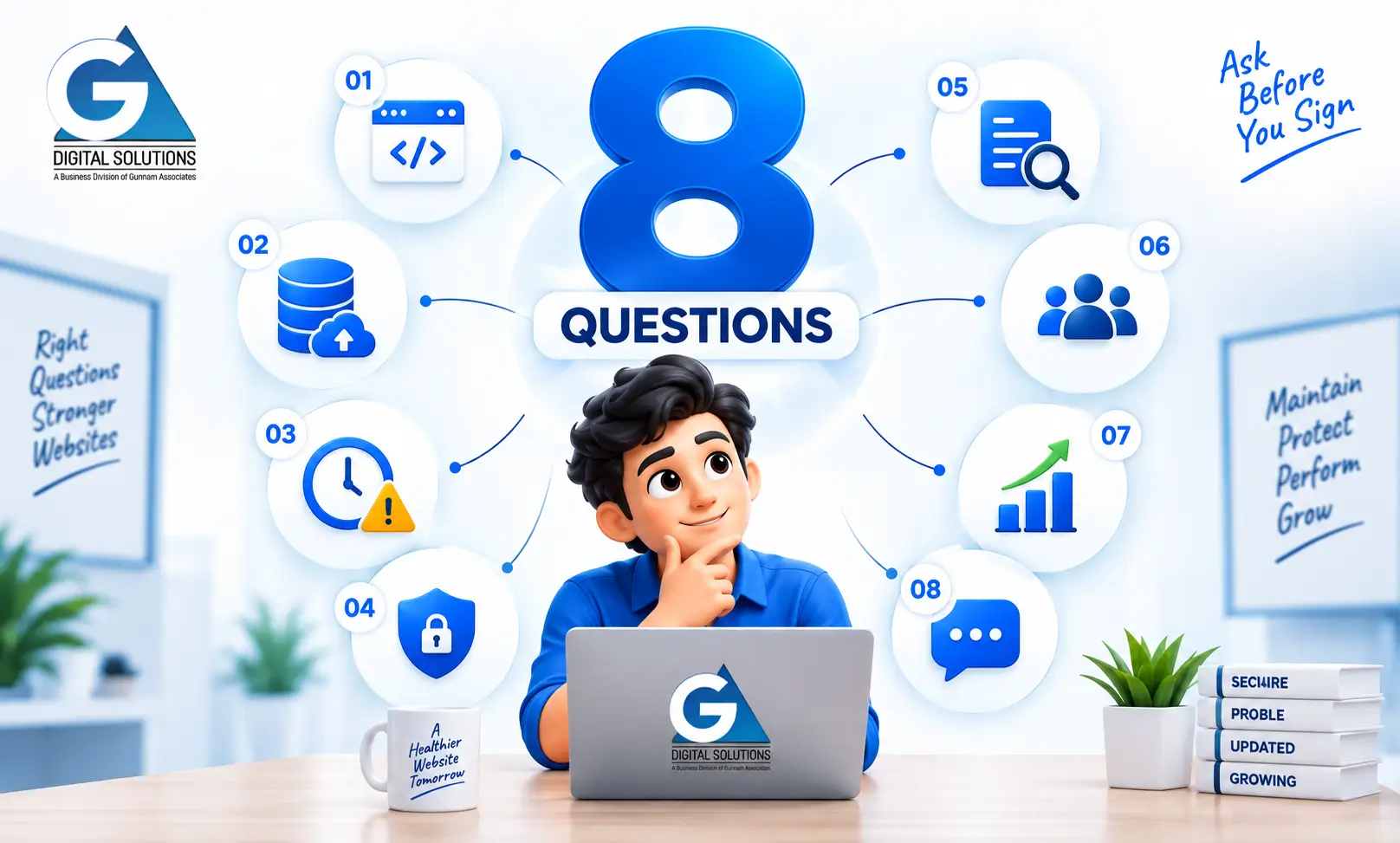
The 8 Questions to Ask Before You Sign
Question 1 — Ask Before You Sign
“How do you apply updates — and do you use a staging environment?”
Why this question matters: Updates applied directly to a live website without testing are the single most common cause of self-inflicted website outages. A plugin compatibility conflict, a theme update that breaks a layout, or a CMS version incompatibility can take your site offline instantly. Without a staging environment, there is no way to catch these issues before they reach your visitors.
| ✅ A strong answer sounds like: | ❌ Red flags to watch for: |
|---|---|
| “We apply all updates in a staging environment first — a private copy of your site — test for at least 24 hours, and only push to live once we’ve confirmed everything is working. We can show you the staging URL for your site.” | “We update everything monthly as part of the plan.” (No mention of staging.) — or — “We’re careful when we do updates.” (No process described, only reassurance.) |
How GA Digital Solutions handles this: All updates are tested in a dedicated staging environment before being applied to your live site. We will never push an untested update live. You will receive a report confirming what was updated and when.
Question 2 — Ask Before You Sign
“Where are my backups stored, and how often are they tested?”
Why this question matters: Backups are the safety net of website maintenance. But not all backups are equal. A backup stored on the same server as your website provides no protection if the server fails. A backup that has never been tested for restorability may not actually work when needed. And a backup that is six months old means six months of your business’s website activity could be lost in a recovery scenario.
| ✅ A strong answer sounds like: | ❌ Red flags to watch for: |
|---|---|
| “Your backups run automatically [daily/weekly]. They are stored off-site in [specific location — Google Drive, AWS S3, etc.]. We test restorability quarterly and will send you a confirmation when we do. You can request a restore test at any time.” | “Yes, we do backups.” (No specifics on frequency, location, or testing.) — or — “Backups are on your hosting server.” (Same-server storage is not a true off-site backup.) |
How GA Digital Solutions handles this: Automated backups run on the schedule appropriate for your site type (daily for e-commerce, weekly for standard sites), stored securely off-site. Restorability is verified periodically. You will receive backup confirmation in your monthly report.
Question 3 — Ask Before You Sign
“What is your response time if my website goes offline or gets hacked?”
Why this question matters: A website going offline at 9pm on a Friday is not a hypothetical. If your maintenance provider only works business hours and takes 24 hours to respond to critical incidents, a weekend outage could mean 60+ hours of downtime before anyone addresses it. For businesses that generate revenue or leads through their website, this is a commercial risk, not just an inconvenience.
| ✅ A strong answer sounds like: | ❌ Red flags to watch for: |
|---|---|
| “For critical incidents — site down or security breach — our SLA is [specific number] hours, 24/7. You have direct WhatsApp access to your account manager. We will acknowledge the issue within [time] and have a resolution timeline within [time].” | “We respond within business hours.” — or — “Just send an email and we’ll get back to you.” — or — No defined SLA at all. |
How GA Digital Solutions handles this: All active maintenance clients have direct WhatsApp access to their account manager. For critical issues (site down, security incident), our response protocol begins within 2 hours, 7 days a week. This is written into the maintenance agreement.
Question 4 — Ask Before You Sign
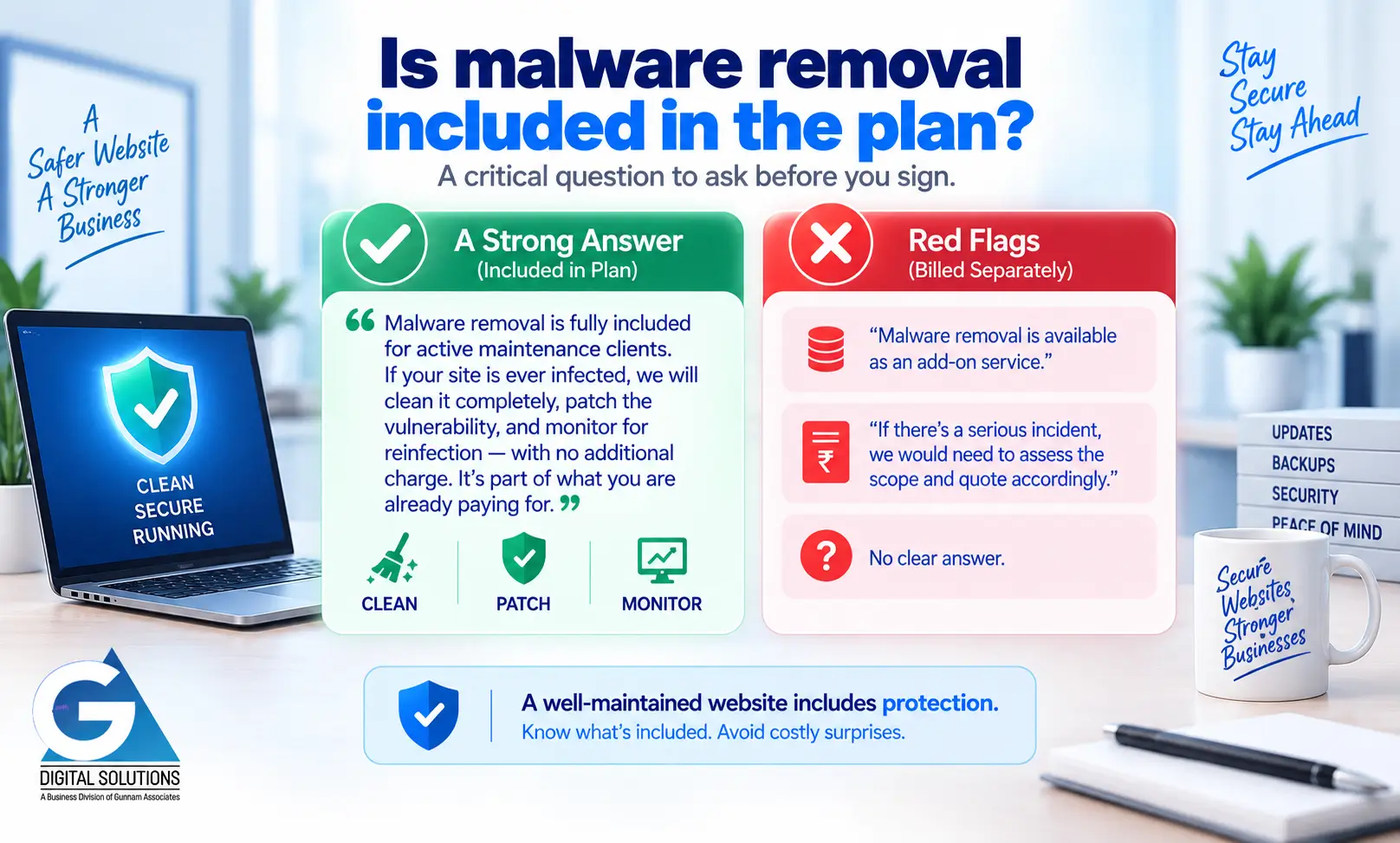
“Is malware removal included in the plan, or is it billed separately?”
Why this question matters: This is one of the most financially important questions to ask, and one of the most commonly overlooked. Many providers in India offer maintenance plans that do not include malware removal — it is treated as an emergency service, billed at ₹20,000–50,000+ when an incident occurs. If your plan does not include it, you are paying for a plan that leaves you exposed to one of the most costly and disruptive incidents a website can experience.
| ✅ A strong answer sounds like: | ❌ Red flags to watch for: |
|---|---|
| “Malware removal is fully included for active maintenance clients. If your site is ever infected, we will clean it completely, patch the vulnerability, and monitor for reinfection — with no additional charge. It’s part of what you are already paying for.” | “Malware removal is available as an add-on service.” — or — “If there’s a serious incident, we would need to assess the scope and quote accordingly.” — or — No clear answer. |
How GA Digital Solutions handles this: Malware removal is fully included in all GA Digital Solutions maintenance plans. Active clients are never billed for emergency security recovery. This is explicitly stated in every maintenance agreement we sign.
Question 5 — Ask Before You Sign
“What does your monthly report include, and can you show me a sample?”
Why this question matters: A monthly report is the primary accountability mechanism in a maintenance relationship. Without it, you have no visibility into what work was actually done, what issues were found, or whether your website is being properly protected. A provider who cannot or will not show you a sample report — or who provides only a one-line summary — is signalling that transparency is not a priority.
| ✅ A strong answer sounds like: | ❌ Red flags to watch for: |
|---|---|
| “Our monthly report documents every task performed, the date it was done, any issues identified, and how they were resolved. It includes your performance metrics, security scan results, backup confirmation, and any recommendations. Here is a sample from a recent client (details anonymised).” | “We’ll let you know if there are any problems.” — or — “We send a brief email each month.” — or — Refusing to share a sample report. |
How GA Digital Solutions handles this: Every client receives a detailed monthly report covering all completed tasks, issues found and resolved, performance metrics, backup confirmation, and forward recommendations. We are happy to share a sample anonymised report during your evaluation.
Question 6 — Ask Before You Sign
“Who specifically will be working on my website, and what happens if they are unavailable?”
Why this question matters: Many maintenance arrangements in India are handled by a single developer or a very small team with no coverage for absence, illness, or departure. If the one person responsible for your website is unavailable — on leave, unwell, or has left the agency — your maintenance may simply stop. Understanding the staffing behind your plan tells you whether the service is robust or fragile.
| ✅ A strong answer sounds like: | ❌ Red flags to watch for: |
|---|---|
| “Your account is managed by [name/role], supported by a team of [number] specialists covering security, performance, and development. If your account manager is unavailable, a designated cover person handles your account. There is no single point of failure in our service.” | “It’s mainly me, but I can bring in help if needed.” — or — No specific answer about who is responsible or what happens in their absence. |
How GA Digital Solutions handles this: GA Digital Solutions operates as a team, not a solo freelancer. Your account manager is supported by dedicated specialists for security, performance, and development work. Cover arrangements are in place for all team members. Service continuity is not dependent on any single individual.
Question 7 — Ask Before You Sign
“Have you worked with websites in my industry, and can you share relevant experience?”
Why this question matters: Website maintenance requirements vary meaningfully by industry. A clinic website with appointment booking functionality has different uptime criticality from a brochure website for a consultancy. An e-commerce store with payment gateway integrations requires a different monitoring approach from a portfolio site. A provider with relevant industry experience understands what matters most for your specific business.
| ✅ A strong answer sounds like: | ❌ Red flags to watch for: |
|---|---|
| “Yes, we have maintained [number] websites in [industry]. The key things we focus on for [industry] websites are [specific, relevant examples]. Here are a couple of examples of similar clients we work with.” (Followed by specific, accurate examples, not generic claims.) | “We work with all types of businesses.” (No specifics.) — or — Claiming extensive experience in your industry without being able to name specific examples or explain what is different about maintaining sites in that sector. |
How GA Digital Solutions handles this: GA Digital Solutions has extensive experience maintaining websites for Indian healthcare practices, real estate developers, educational institutions, and e-commerce businesses. We are happy to share relevant experience and references in your sector during evaluation.
Question 8 — Ask Before You Sign
“What happens at the end of the contract if I want to move to a different provider?”
Why this question matters: An often-overlooked question with significant practical importance. Some providers hold your website, hosting credentials, or domain access in a way that creates dependency. Understanding the exit process before you sign tells you whether the provider is confident in their service quality or relies on lock-in to retain clients.
| ✅ A strong answer sounds like: | ❌ Red flags to watch for: |
|---|---|
| “At the end of the contract, we provide you with a full handover document including all credentials, configurations, and documentation of your website’s setup. Your website is yours — we do not hold any access that you cannot reclaim. The transition to a new provider is straightforward.” | “We would need to discuss the transition.” (Vague.) — or — Any indication that they control your domain, hosting, or code in a way that is not easily transferable. — or — Contract terms that penalise early exit without cause. |
How GA Digital Solutions handles this: All GA Digital Solutions clients retain full ownership and control of their website, domain, and hosting. At the end of any engagement, we provide a complete handover package. We believe client retention should come from service quality, not lock-in.
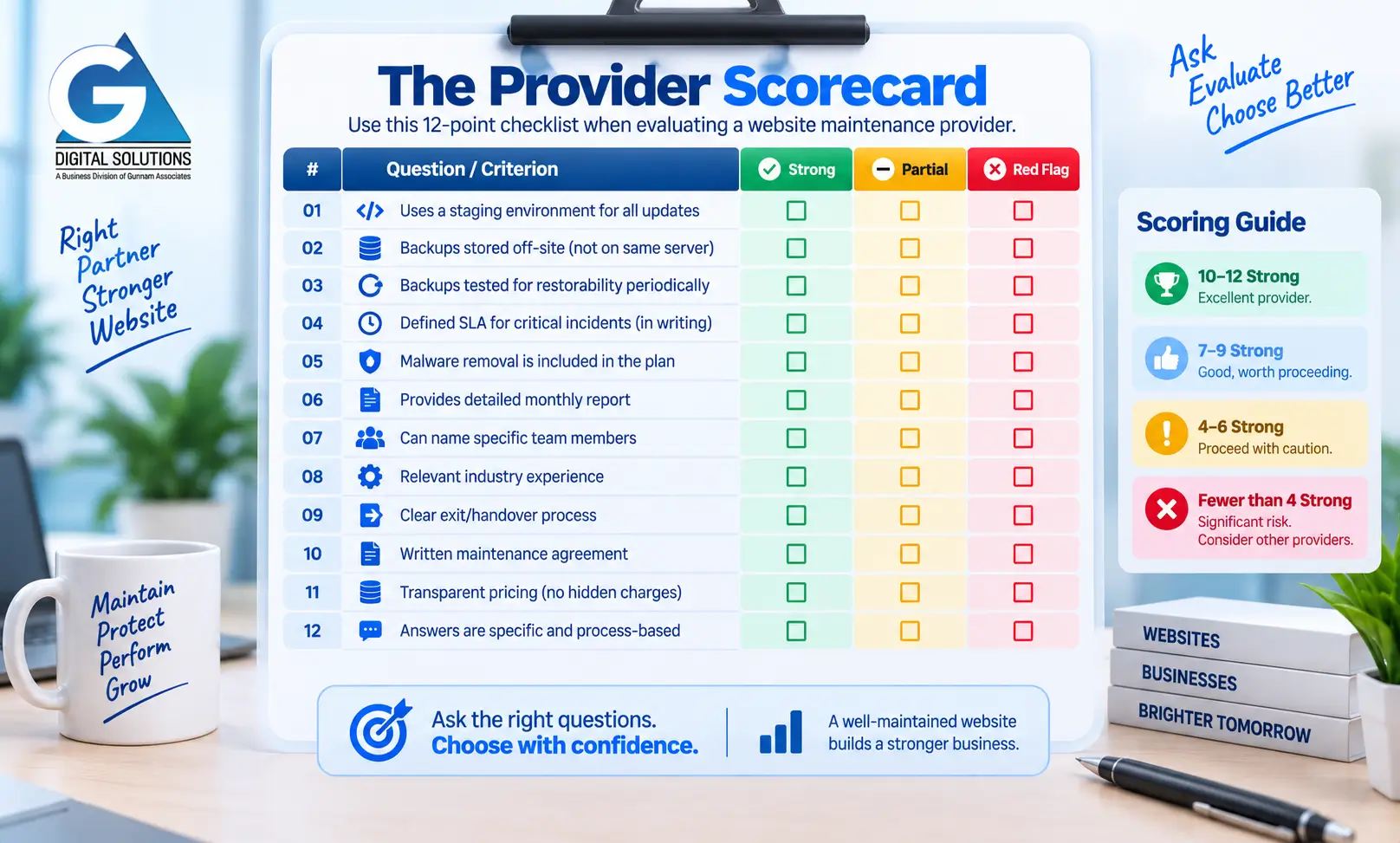
The Provider Scorecard: Use This When Evaluating
Print this scorecard and use it when speaking to any maintenance provider. For each question, mark whether their answer was strong, acceptable with reservations, or a red flag. A provider with multiple red flags should not be engaged, regardless of price.
| ✓ | Question / Criterion | Strong | Partial | Red flag |
|---|---|---|---|---|
| 1 | Uses a staging environment for all updates — never live-site-only | ☐ | ☐ | ☐ |
| 2 | Backups stored off-site (not on same server) with confirmed frequency | ☐ | ☐ | ☐ |
| 3 | Backups tested for restorability periodically | ☐ | ☐ | ☐ |
| 4 | Defined SLA for critical incidents (site down / hacked) — in writing | ☐ | ☐ | ☐ |
| 5 | Malware removal is included in the plan — not billed separately | ☐ | ☐ | ☐ |
| 6 | Provides detailed monthly report — willing to show a sample | ☐ | ☐ | ☐ |
| 7 | Can name specific team members and cover arrangements | ☐ | ☐ | ☐ |
| 8 | Relevant industry or business-type experience — with examples | ☐ | ☐ | ☐ |
| 9 | Clear exit/handover process — no lock-in on your credentials | ☐ | ☐ | ☐ |
| 10 | Written maintenance agreement specifying scope, SLA, and inclusions | ☐ | ☐ | ☐ |
| 11 | Transparent pricing — no hidden emergency or add-on charges | ☐ | ☐ | ☐ |
| 12 | Response to questions is specific and process-based — not vague reassurance | ☐ | ☐ | ☐ |
Scoring guide: 10–12 Strong responses = excellent provider. 7–9 Strong = good, worth proceeding with written agreement. 4–6 Strong = proceed with caution; get everything in writing. Fewer than 4 Strong = significant risk; consider other providers.
What a Good Maintenance Agreement Should Include
Beyond verbal answers, a professional maintenance provider should be willing to formalise their commitments in a written agreement. If a provider is reluctant to put anything in writing, that tells you everything you need to know.
- ✅ Explicit scope of services — a list of every task included, with frequency
- ✅ Defined SLA for critical issues — response time and resolution timeline in writing
- ✅ Confirmation that staging environment is used for updates
- ✅ Backup frequency, storage location, and testing commitment
- ✅ Malware removal included or explicitly excluded (with cost if excluded)
- ✅ Monthly report format and delivery schedule
- ✅ What is NOT included — so there are no surprises about add-on charges
- ✅ Clear exit terms — what happens at end of contract, handover process
- ✅ Data protection and confidentiality provisions
- ✅ Escalation process if you are unhappy with service quality
If a provider offers a verbal agreement only, or a very brief "terms of service" without specific scope, treat this as a meaningful risk indicator. Professional maintenance relationships need written commitments to be accountable.
→ Want to See How GA Digital Solutions Answers These 8 Questions? Get in Touch
We are happy to answer every one of these questions in writing before you make any decision. Start with a free 20-point website health audit — no cost, no obligation.
Three Questions to Ask Yourself Before You Start
Before evaluating providers, it helps to be clear about your own requirements. The right provider for a high-traffic e-commerce store is different from the right provider for a five-page brochure site.
1. What is the business impact if my website goes offline for 24 hours?
If the answer is “massive” — you lose bookings, orders, or leads every hour — you need a provider with a strong SLA and 24/7 monitoring. If the answer is “minimal” — your website is informational and traffic is low — a standard plan with business-hours response may be adequate.
2. What is the most important thing that could go wrong with my website?
For a healthcare business: appointment booking going down. For an e-commerce store: payment gateway failure. For a professional services firm: client trust damage from a security warning. Knowing your primary risk helps you evaluate whether a provider’s response processes address what matters most to you.
3. What level of involvement do I want in my website’s maintenance?
Some business owners want to be informed of every change and approve major updates. Others want the entire process handled without needing to think about it. Being clear about your preference allows you to assess whether a provider’s communication style matches your expectations before you commit.
Frequently Asked Questions
Yes, and a reputable provider should be willing to offer them. References are particularly useful for verifying claims about response times, communication quality, and how the provider handles incidents. If a provider declines to offer any references, ask why. A lack of available references — especially for an established agency — warrants scrutiny.
Trust your instinct. Beyond the technical answers, pay attention to how quickly they respond to your enquiry, how clearly they communicate, and whether they seem genuinely interested in understanding your website’s requirements or just closing a deal. The maintenance relationship is ongoing — communication quality before the contract is often a reliable predictor of communication quality during it.
For a new provider relationship, starting month-to-month gives you flexibility to switch if service quality does not meet expectations. Many providers offer a discount for annual prepayment — once you have established trust and confirmed the quality of service over 2–3 months, an annual arrangement can save 10–20%. Avoid committing to long-term contracts with a provider you have not yet worked with, regardless of the discount offered.
Have the conversation directly. Ask your provider the questions from this guide and see how they respond. If the answers are vague, incomplete, or your provider becomes defensive, that is useful information. You may decide to renegotiate the scope of your current arrangement, or to seek a new provider. Either outcome is preferable to continuing with a maintenance arrangement that is not actually protecting your website.
We begin every new maintenance engagement with a structured technical audit of your existing website. This covers security status, plugin and software versions, backup integrity, performance baseline, and any outstanding issues. We document the findings, walk you through them, and establish a maintenance baseline before the ongoing plan begins. You know exactly what you are starting with — no hidden surprises after the first month.
Summary
Choosing a website maintenance company is a decision worth taking seriously. The consequences of a bad choice are not just a service you dislike — they are a website that is not actually protected, risks you are not aware of, and incidents you could have avoided.
The eight questions in this guide give you a reliable framework for evaluating any provider in India. Strong, specific, process-based answers signal a professional service. Vague, reassuring-but-unspecific answers signal a service that may not deliver what it promises.
Use the scorecard, get commitments in writing, and trust your assessment of how a provider communicates during the evaluation. Those signals do not change after the contract is signed.
→ Ask GA Digital Solutions These 8 Questions — We Will Answer Every One in Writing
Continue Reading
Explore the full GA Digital Solutions website maintenance guide series.
GA Digital Solutions is a full-service digital agency based in Hyderabad, India. We provide website maintenance, design and development, SEO, performance marketing, and lead management services to businesses across India.
Page last reviewed: May 2026
