








Why Website Maintenance Is Important: 10 Risks of Neglecting Your Site
Last updated: April 2026 · 11-minute read · By GA Digital Solutions, Hyderabad
Most business owners in India think about their website in two stages: building it, and then occasionally updating the content. The ongoing technical work of keeping it healthy rarely enters the picture.
That gap has consequences — and they are not small.
A neglected website is not just a website that could be better. It is a website that is actively accumulating risk: security vulnerabilities, speed problems, broken functionality, and a slow erosion of the trust and search visibility that took time and money to build.
This article walks through ten of the most significant risks of neglecting website maintenance — what happens, why it happens, and what prevents it. If you have been putting off addressing your website's upkeep, this is the honest picture.
The 10 Risks of Neglecting Website Maintenance
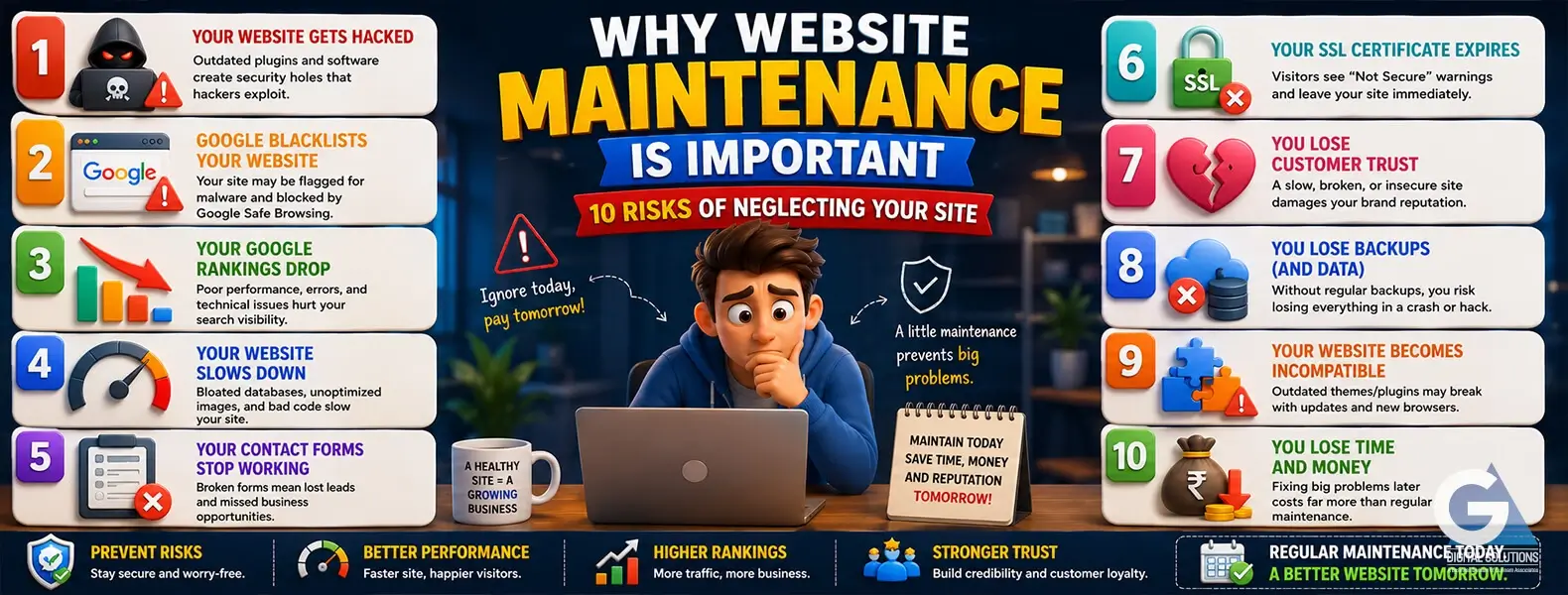
1. Your Website Gets Hacked
This is the most common and most damaging consequence of neglected website maintenance. The majority of website hacks do not happen because of sophisticated, targeted attacks. They happen because a plugin or platform version is outdated and contains a known vulnerability — one that automated bots scan for constantly.
A hacked website can be used to serve malware to your visitors, redirect your traffic to fraudulent pages, steal customer data, or simply take your website offline. In many cases, the business owner does not discover the breach for days or even weeks — by which point the damage is already done.
✔ The fix: Regular software updates (plugins, themes, platform core) and active security monitoring close these vulnerabilities before they can be exploited.
2. Google Blacklists Your Website
When Google detects that a website is serving malware or has been compromised, it adds the site to its Safe Browsing blacklist. Visitors using Chrome — the most widely used browser in India — see a full-screen red warning page before they can access your site.
The consequences are severe and lasting. Your organic search traffic collapses overnight. Even after the malware is removed and the site is reported as clean, it can take weeks for Google to lift the blacklisting and for rankings to recover. Throughout this period, your website is effectively invisible to new customers.
✔ The fix: Proactive malware scanning and security hardening prevent the conditions that trigger a Google blacklisting.
3. Your Google Rankings Drop
Website maintenance and search engine performance are directly connected. Google uses page speed, mobile usability, Core Web Vitals scores, HTTPS security, crawl error rates, and overall site health as ranking factors. When these degrade — as they naturally do in the absence of maintenance — your rankings follow.
The decline is rarely dramatic and sudden. It tends to be gradual: a position or two per month, across multiple keywords. By the time the drop is noticeable, months of compounding decline have already occurred, and recovery takes significantly longer than prevention would have.
✔ The fix: Regular performance audits, speed optimisation, broken link resolution, and Core Web Vitals monitoring maintain and improve the technical signals that Google rewards.

4. Your Website Slows Down
Website speed degrades over time without active management. Databases accumulate unnecessary records, image files are never compressed, caching configurations drift out of optimal settings, and plugin updates introduce code conflicts that increase load time.
For Indian users — many of whom access websites on mobile devices over variable network connections — slow load times have a direct and measurable impact. Research consistently shows that more than half of mobile users abandon a website that takes longer than 3 seconds to load. Each additional second of delay reduces conversion rates further.
✔ The fix: Database optimisation, image compression, caching reviews, and regular performance audits keep load times within the ranges that retain visitors and satisfy Google.
5. Your Contact Forms and CTAs Stop Working
Forms break silently. A plugin update, an email configuration change, a hosting environment adjustment — any of these can cause your contact form, booking system, or quote request form to stop sending submissions. Visitors fill in the form and hit submit. Nothing arrives.
The business loses enquiries it does not know it is losing. This is one of the most insidious effects of neglected maintenance because there is no error message, no alert, and no obvious sign that anything is wrong. The only signal is an unexplained drop in leads — which can take weeks or months to attribute correctly.
✔ The fix: Monthly functionality checks — submitting a test entry through every form and verifying delivery — catch these failures before they cost the business weeks of missed enquiries.
6. Your SSL Certificate Expires
An SSL certificate is what creates the padlock in your browser's address bar and the "https" in your URL. It signals to visitors and to Google that your website is secure. SSL certificates expire — typically annually — and when they do, visitors are shown a browser warning that reads: "Your connection is not private."
Most visitors, presented with this warning, leave immediately. They do not investigate. They do not click through. They go to a competitor. And for the duration of the lapse — which can persist for days or weeks if no one is monitoring it — your website is actively driving potential customers away.
✔ The fix: SSL certificate monitoring with automatic renewal reminders ensures the padlock never expires without warning. This is a basic component of any professional maintenance plan.
7. You Lose All Your Website Data
Businesses that do not have a current, tested backup of their website have, in effect, no safety net. A server failure, an accidental deletion, a failed update that corrupts the database, a ransomware attack — any of these scenarios can result in the complete loss of the website and all its content.
Rebuilding a website from scratch after a total data loss is expensive, time-consuming, and disruptive. In the best case, you lose weeks of work. In the worst case, you lose years of content, customer data, and settings that were never documented anywhere.
✔ The fix: Automated, regular off-site backups — taken daily for active sites, weekly for stable ones — and periodic restoration tests to confirm they actually work, eliminate this risk entirely.

8. Broken Links Accumulate and Frustrate Visitors
As websites evolve — pages are deleted, URLs are changed, external websites go offline — links that once worked begin returning 404 errors. A visitor who clicks a navigation link or a blog reference and lands on an error page does not assume a technical glitch. They assume the website is poorly run.
Beyond the visitor experience, broken links affect SEO. Internal links that lead nowhere waste your site's crawl budget. External links to dead pages signal to Google that your website is not actively curated. Neither helps your rankings.
✔ The fix: Regular broken link scans — checking both internal navigation and outbound links — identify and resolve these issues before they accumulate into a significant problem.
9. Your Website Becomes Incompatible with Modern Browsers and Devices
Browser standards evolve. Screen sizes multiply. New device types emerge. A website that looked and worked perfectly when it was built three years ago may render incorrectly in the latest version of Chrome, break on a newer iPhone model, or fail to load certain features on Android browsers that have been updated since launch.
These compatibility issues tend to go unnoticed by the business owner — who may still be viewing the site on the same device and browser used at launch — while a growing proportion of potential customers encounter a broken experience.
✔ The fix: Periodic cross-browser and cross-device testing, combined with keeping themes and front-end code updated, maintains compatibility as the technology landscape evolves.
10. Your Credibility and Brand Trust Erode
A website that is slow, breaks occasionally, shows security warnings, or contains outdated information does not just lose individual visitors. It creates a persistent impression of a business that is unreliable, inattentive to detail, or possibly no longer operating.
For professional service providers, healthcare businesses, educational institutions, and any business where trust is the foundation of the customer relationship, this erosion of credibility is the most consequential risk of all. A potential customer who visits your website and loses confidence is unlikely to come back — and may tell others about the experience.
✔ The fix: Consistent, professional website maintenance is not just a technical investment. It is a brand investment. A well-maintained website signals to every visitor that your business is active, trustworthy, and takes its commitments seriously.
The Cumulative Effect: Why These Risks Compound
Individually, any one of these risks is serious. Together, they interact and reinforce each other in ways that accelerate the damage.
A slow website earns lower Google rankings, which means fewer visitors. Fewer visitors means less scrutiny of the website, which means problems go unnoticed longer. An unnoticed security vulnerability leads to a hack. A hack leads to a Google blacklisting. A Google blacklisting collapses rankings completely — and by this point, the website that was neglected for cost-saving reasons has become an active liability requiring expensive emergency intervention.
This is the maintenance debt cycle, and it plays out for thousands of Indian business websites every year.
The businesses that invest in ongoing website maintenance are not paying to prevent inconvenience. They are preventing a compounding chain of consequences that, left to run its course, costs far more than the maintenance itself.
What Does Website Neglect Actually Cost?
The costs of a neglected website are both direct and indirect. Here is a realistic picture.
| Incident | Estimated Cost Impact |
|---|---|
| Malware removal and security cleanup | ₹15,000 – ₹50,000 (emergency rate) |
| Emergency developer intervention | ₹10,000 – ₹30,000 per incident |
| Google ranking recovery (SEO) | 3 – 6 months of reduced organic traffic |
| Google blacklisting recovery | Weeks of near-zero traffic + brand damage |
| Website rebuild after total data loss | ₹50,000 – ₹3,00,000+ depending on complexity |
| Revenue lost during downtime | Variable — ₹10,000 to lakhs per day for active e-commerce |
| Leads lost from broken forms (undetected) | Variable — often weeks of missed enquiries before noticed |
| SSL warning: visitor loss rate | Up to 85% of visitors leave on seeing the security warning |
Annual professional website maintenance: ₹36,000 – ₹1,80,000.
A single serious incident: ₹25,000 – ₹3,00,000+.
Maintenance is not the expense. Neglect is.
→ Find out where your website stands. Get a free 20-point health audit today.
What Professional Website Maintenance Actually Prevents
The 10 risks above are not inevitable. Every single one of them is preventable with a consistent, professional maintenance approach. Here is what that looks like in practice.
| Without Maintenance | With Professional Maintenance |
|---|---|
| ✗ Outdated software with known vulnerabilities | ✔ Updates tested and applied monthly in staging |
| ✗ Security breaches discovered after the fact | ✔ Real-time scanning with immediate alerts |
| ✗ Backups that may or may not exist | ✔ Automated, tested, off-site backups on schedule |
| ✗ Slow pages that drive visitors away | ✔ Regular speed audits and performance optimisation |
| ✗ Broken forms losing leads for weeks | ✔ Monthly functionality checks across all CTAs |
| ✗ Expired SSL showing security warnings | ✔ Certificate monitoring with renewal reminders |
| ✗ Declining rankings from technical issues | ✔ Core Web Vitals and crawl health kept in check |
| ✗ No data if something goes catastrophically wrong | ✔ Full restoration from tested backup within hours |
Is Your Website Currently at Risk?
Here are six questions to ask yourself right now. If you cannot confidently answer yes to all of them, your website has uncovered risk that needs addressing.
- Do you know when your website's plugins and platform were last updated?
- Can you confirm that automated backups are being taken and stored off-site?
- Has your SSL certificate been checked in the last 30 days?
- Have you submitted a test entry through your contact form and confirmed it arrived in the last month?
- Do you have uptime monitoring in place that would alert you immediately if your website went down?
- Has your website been scanned for malware in the last 30 days?
If you are unsure about even one of these, it is worth getting a professional audit. Our free 20-point website health audit covers all of the above — and more — at no cost and with no obligation.
How Often Should Website Maintenance Happen?
Different maintenance tasks operate on different schedules. Here is a practical summary.
| Frequency | Tasks |
|---|---|
| Daily | Uptime monitoring · Security scanning · Backups (e-commerce and high-traffic sites) |
| Weekly | Plugin update review · Performance check · Backups (standard sites) |
| Monthly | Software updates (tested in staging) · Broken link checks · SSL check · Database optimisation · Form functionality test · Analytics report |
| Quarterly | Full security audit · Core Web Vitals review · Content audit · SEO technical health check |
For a detailed breakdown of each task and what it involves, see our Complete Website Maintenance Checklist.
Frequently Asked Questions
Yes. Most of the risks described in this article are invisible to the casual observer. Outdated plugins, database bloat, slow load times on certain devices, and malware infections can all exist without any visible sign on the front end of the website. The only way to know your website is genuinely healthy is to check the things that are not visible from the outside.
It depends on the arrangement. Some web developers offer ongoing maintenance as part of their service. Many do not. If you are unsure whether your current developer is actively maintaining your website, ask them specifically: when were the plugins last updated? Are backups being taken? The answer will tell you what you need to know.
Emergency malware removal and security cleanup typically costs between ₹15,000 and ₹50,000 in India, depending on the extent of the infection and the platform. If data has been lost, or if rankings need to be recovered after a Google blacklisting, the total cost is significantly higher. Professional maintenance — which prevents hacks rather than reacting to them — costs a fraction of this on a monthly basis.
If we had to choose one, it would be keeping software updated — platform, plugins, and themes. Outdated software is the most common entry point for hackers, and it is also the most straightforward to prevent. But in practice, all the tasks in this guide work together. Neglecting any one of them leaves a gap that the others cannot fully compensate for.
The best starting point is a professional website audit. This gives you an accurate baseline — what is working, what needs attention, and what represents an active risk. GA Digital Solutions offers a free 20-point website health audit for businesses in Hyderabad and across India. There is no obligation to proceed with a maintenance plan afterwards, but the audit will give you a clear picture of where things stand.
Summary
Website maintenance is not optional for businesses that rely on their websites to attract customers, generate enquiries, and build trust. The 10 risks outlined in this article — from hacking and blacklisting to broken forms and eroding credibility — are all preventable, and all significantly more costly to fix than to prevent.
The question for every business owner is not whether to maintain their website. It is whether to do it proactively — through regular, professional maintenance — or reactively, through expensive emergency responses to problems that could have been caught months earlier.
Proactive is always the better answer.
→ Get Your Free 20-Point Website Health Audit — No Cost, No Obligation
Our team will complete the audit within 2 business days and walk you through the findings on a call or via WhatsApp — whichever you prefer.
Continue Reading
Explore the full GA Digital Solutions guide series on website maintenance for Indian businesses.
Start Here
Go Deeper
Compare & Decide
- Website Maintenance Cost in India
- DIY vs Professional Website Maintenance
- How to Choose a Website Maintenance Company
- Website Maintenance Services in Hyderabad
- Why Outsourcing Website Maintenance Makes Sense in 2026
- Website Maintenance Contract: What to Include
- Website Maintenance for Healthcare Businesses
GA Digital Solutions is a full-service digital agency based in Hyderabad, India. We provide website maintenance, design and development, SEO, performance marketing, and lead management services to businesses across India.
