




A Full Service Digital Marketing Agency


Website Maintenance for Healthcare Businesses

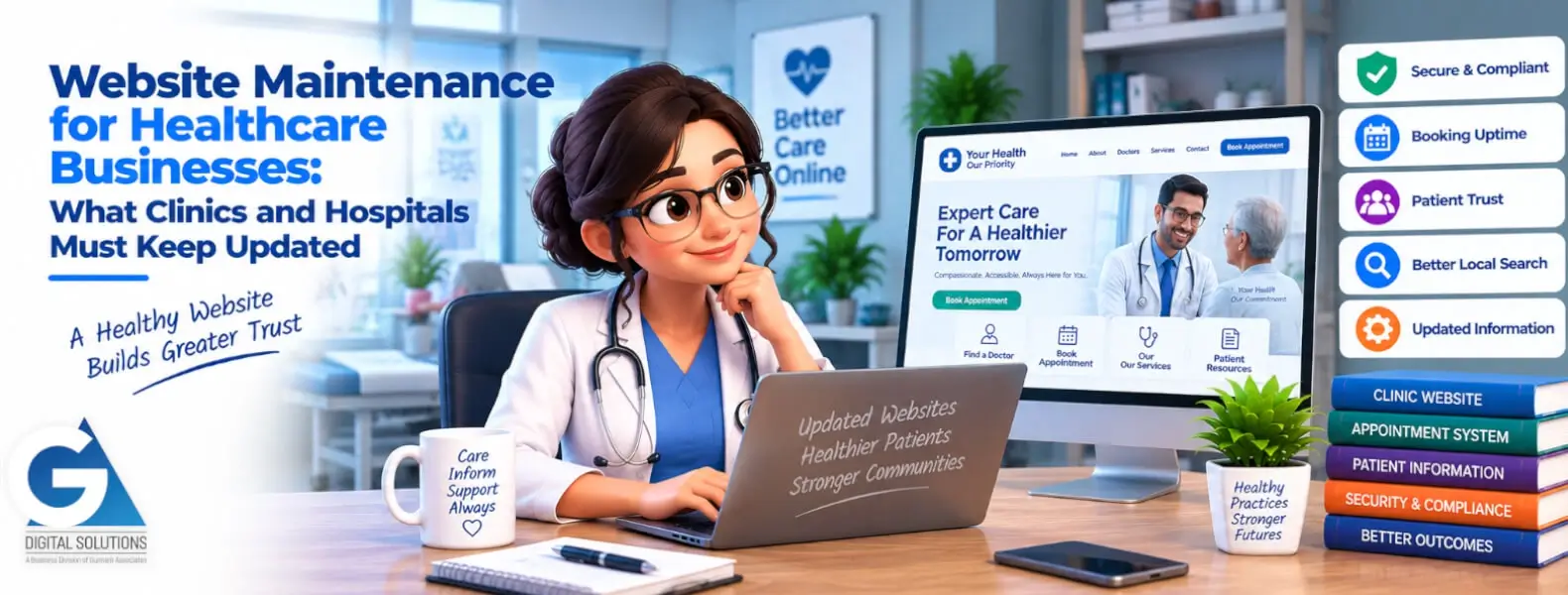
Website Maintenance for Healthcare Businesses: What Clinics and Hospitals Must Keep Updated

Last updated: May 2026 · 8-minute read · By GA Digital Solutions, Hyderabad

For a clinic, hospital, or diagnostic centre, the website is not simply a marketing tool. It is the first point of contact for patients making decisions about their health — decisions that require trust, clarity, and confidence in the practice.

A healthcare website that is slow, insecure, or poorly maintained does not just lose a visitor. It may lose a patient who needed your care, to a competitor whose website communicated reliability more effectively.

Healthcare businesses in India face specific website maintenance challenges that generic guides do not address. This article covers them directly: what matters most, how often it needs attention, and what the consequences of neglect look like in a healthcare context.

This is a specialist vertical guide. For the full website maintenance framework applicable to all business types, see the Website Maintenance Services pillar page.

Why Healthcare Websites Have Higher Maintenance Stakes
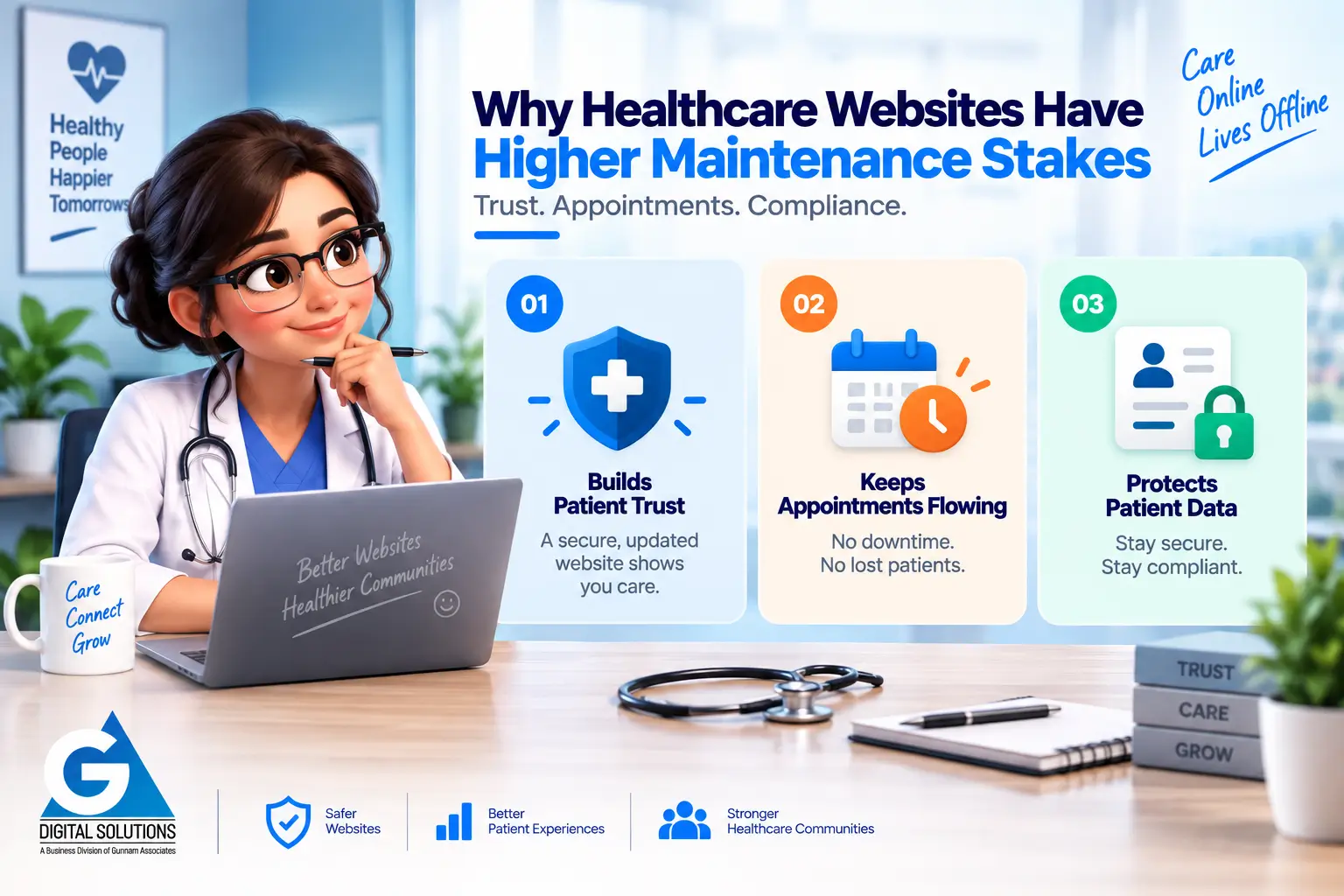
Three factors make website maintenance particularly critical for Indian healthcare businesses.

1. Patient trust is the product

A patient researching a specialist or booking an appointment is making a health decision. They are assessing whether to trust you with something profoundly personal. A website with a security warning, an expired SSL certificate, broken contact forms, or outdated information immediately signals unreliability — and most patients will simply choose a different practice.

2. Appointment booking downtime has direct revenue consequences

For clinics that rely on online appointment booking, every hour the booking system is down is revenue lost and patients underserved. Unlike a product company that can recover a lost sale later, a missed appointment slot is simply gone. The uptime standard for healthcare websites must be higher than for general business websites.

3. Patient data carries legal and ethical obligations

Even basic contact forms on healthcare websites collect sensitive information — patient names, phone numbers, health queries. India’s Digital Personal Data Protection Act, 2023 imposes responsibilities on any organisation processing personal data. A hacked or insecure healthcare website is not just a technical problem — it is a potential compliance and liability issue.

The Healthcare Website Maintenance Priority Table

The following tasks are standard website maintenance requirements for all businesses. For healthcare websites, the frequency and urgency of several tasks is elevated. This table reflects those healthcare-specific priorities.

Maintenance Task Frequency Why It Matters for Healthcare
Uptime monitoring24/7Appointment booking downtime means lost patients and lost revenue. A 2-hour response SLA is the minimum standard for any clinic with online booking.
Appointment booking testWeeklyTest the full booking flow end-to-end weekly. Confirm appointments are being received. A broken booking system may show no visible error while silently discarding patient submissions.
Contact form testWeeklyPatient enquiry forms must be tested separately from booking systems. Test and confirm receipt every week without exception.
Security scanMonthlyPatient data in contact forms and booking records makes healthcare sites a higher-value target. Monthly malware scanning with daily automated monitoring is the appropriate standard.
SSL certificate monitoringMonthlyAn SSL warning on a healthcare website destroys patient trust instantly. Monitor expiry date and renew 60 days in advance.
Doctor and staff profilesMonthlyStaff changes, qualification updates, and new team members must be reflected accurately. Outdated profiles undermine credibility and can create medico-legal issues.
Service and department pagesMonthlyServices offered, consultation fees (where listed), and location details must be current. A patient arriving for a service that is no longer offered creates a poor experience and reputational risk.
Backup (including patient enquiry data)DailyAppointment records and patient contact data must be backed up daily. A data loss incident at a healthcare practice carries both operational and compliance consequences.
Page speed (mobile)MonthlyMost patients search on mobile. A slow-loading clinic website loses patients at the exact moment of intent. Mobile speed directly affects local search rankings.
Local SEO signals (NAP, schema)QuarterlyName, Address, Phone number must be consistent across website, Google Business Profile, and local directories. Schema markup for medical practices supports local search visibility.
WhatsApp and phone CTAsWeeklyFor many Indian patients, WhatsApp is the preferred contact channel. Confirm WhatsApp links, click-to-call buttons, and all contact CTAs are functional.

The Specific Risks of a Neglected Healthcare Website
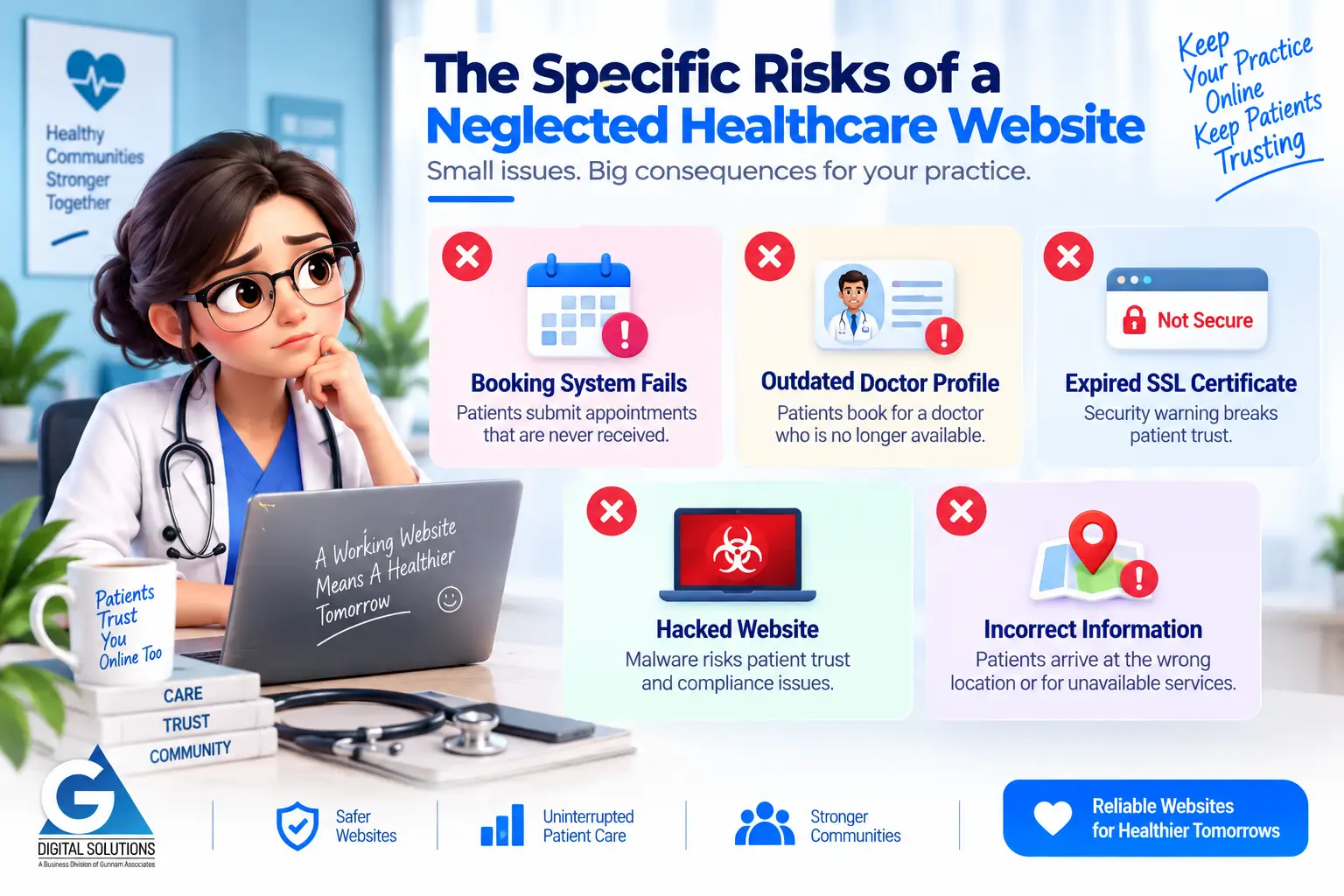
  • ❌ A booking system that stops working silently — patients submit appointments that are never received. The practice does not know until a patient calls to enquire about a confirmation.
  • ❌ An outdated doctor profile showing a specialist who has left the practice — patients book for a doctor who is no longer available, damaging trust and creating operational disruption.
  • ❌ A security warning from an expired SSL certificate displayed to patients seeking an appointment — an immediate signal of unreliability in a context where trust is the primary currency.
  • ❌ A hacked website serving malware to patients — a breach of patient trust and a potential DPDP Act compliance issue.
  • ❌ Outdated service information or incorrect contact details — patients arrive at the wrong location, at the wrong time, or for a service that is no longer offered.

For healthcare businesses, a broken contact form or appointment booking system is not a minor technical issue. It is a direct barrier between a patient in need and the care your practice provides. The standard of maintenance should reflect that.

What a Healthcare Maintenance Plan Should Include
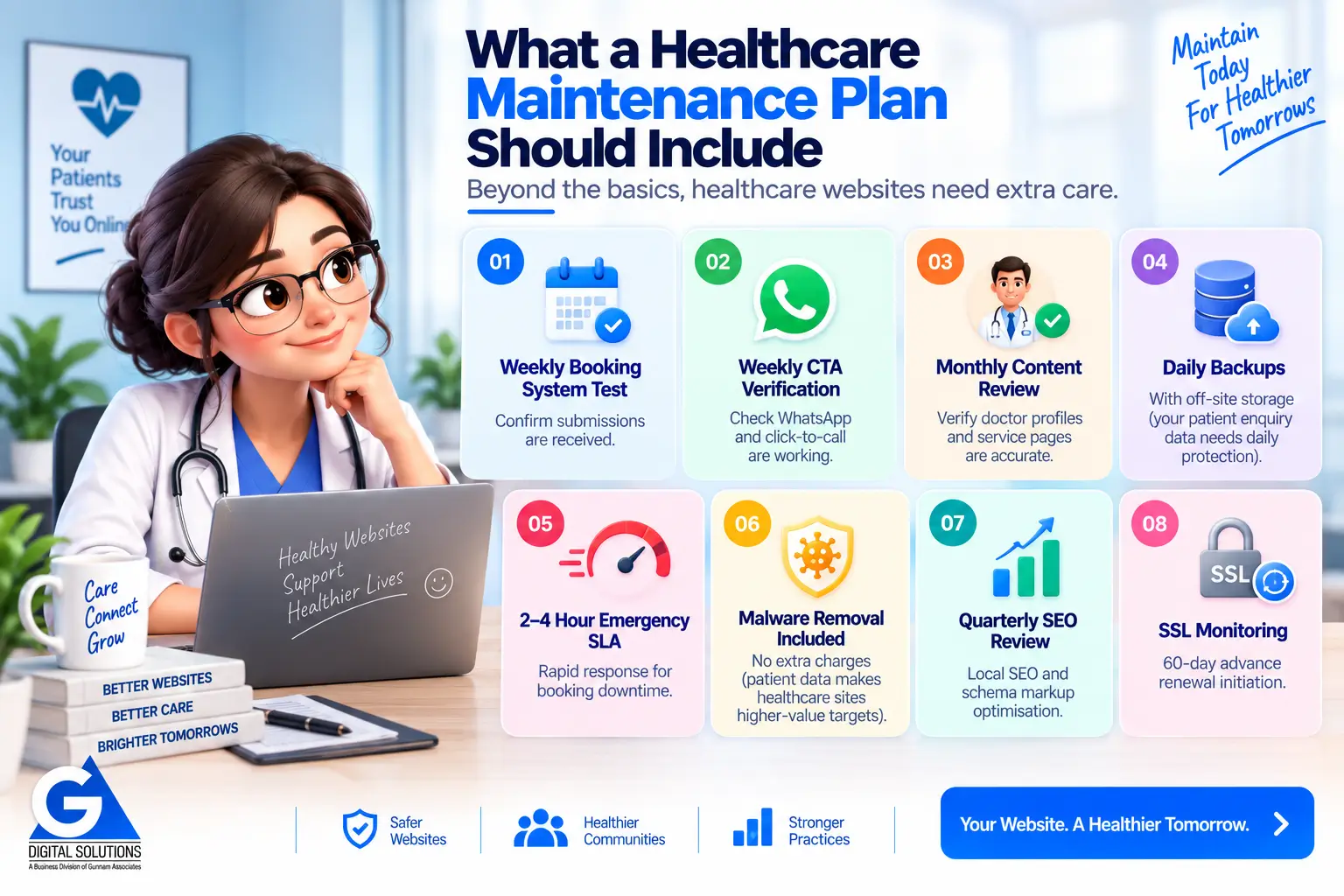
Beyond standard website maintenance, a plan for a healthcare website should specifically include:

  • ✅ Weekly booking system end-to-end test — not just checking the form displays, but confirming submissions are received
  • ✅ Weekly WhatsApp and click-to-call CTA verification
  • ✅ Monthly doctor profile and service page accuracy review
  • ✅ Daily backups with off-site storage (not weekly — patient enquiry data requires daily protection)
  • ✅ 2–4 hour emergency SLA — booking downtime at a healthcare practice warrants rapid response
  • ✅ Malware removal included in plan (not extra-charge) — patient data makes healthcare sites higher-value targets
  • ✅ Quarterly local SEO and schema markup review
  • ✅ SSL certificate monitoring with 60-day advance renewal initiation

→ Get a Free 20-Point Healthcare Website Audit from GA Digital Solutions

We maintain websites for clinics and healthcare practices across Hyderabad and India. Our free audit covers all the healthcare-specific priorities above. No cost, no obligation.

Frequently Asked Questions

Yes — arguably more than a large hospital, because a small clinic has no IT team to respond when something goes wrong. A broken booking system or a hacked website takes a single-doctor clinic offline entirely until it is fixed. Professional maintenance with a defined response SLA ensures someone responds within hours, not days.

India does not currently mandate specific healthcare-compliant hosting in the way that HIPAA regulations do in the USA. However, the DPDP Act, 2023 imposes data protection obligations on any organisation processing personal data. You should ensure your hosting provider has reasonable security standards and that your maintenance plan includes the security practices described in this guide. Consult a legal advisor for specific compliance guidance.

Yes. The third-party booking platform handles its own maintenance. Your website — the pages patients visit before clicking through to book — still needs to be fast, secure, and accurate. The integration between your website and the booking platform (the button, the link, the embedded widget) also needs regular testing.

Any time there is a change — a new team member, a departed doctor, a new service, a change in consultation fees or hours. Additionally, a monthly sweep of all profile and service pages should be part of your maintenance routine to catch anything that has drifted out of date.

We maintain healthcare websites across all major platforms including WordPress, Wix, Squarespace, and custom-built websites. The specific maintenance tasks vary by platform, but the core priorities — booking functionality, security, speed, accuracy, and backup — apply across all of them.

Summary

Healthcare websites carry higher maintenance stakes than most business websites because patient trust, booking uptime, and data protection are all directly at risk when maintenance is neglected.

The key priorities for any healthcare practice: weekly booking system and contact form testing, daily backups, monthly security scanning, SSL monitoring, staff profile accuracy, and a maintenance plan with a fast emergency response SLA.

GA Digital Solutions has direct experience maintaining websites for clinics, hospitals, and diagnostic centres across Hyderabad. Our free 20-point healthcare website audit is the right starting point for any practice that wants to know where its website currently stands.

→ Get My Free Healthcare Website Audit — Hyderabad & Across India

Continue Reading

Explore the full GA Digital Solutions website maintenance guide series.


GA Digital Solutions is a full-service digital agency based in Hyderabad, India. We provide website maintenance, design and development, SEO, performance marketing, and lead management services to businesses across India.

Page last reviewed: May 2026

creative-1

Digital Marketing Agency

Website Maintenance for Healthcare Businesses

Website Maintenance for Healthcare Businesses: What Clinics and Hospitals Must Keep Updated

Last updated: May 2026 · 8-minute read · By GA Digital Solutions, Hyderabad

For a clinic, hospital, or diagnostic centre, the website is not simply a marketing tool. It is the first point of contact for patients making decisions about their health — decisions that require trust, clarity, and confidence in the practice.

A healthcare website that is slow, insecure, or poorly maintained does not just lose a visitor. It may lose a patient who needed your care, to a competitor whose website communicated reliability more effectively.

Healthcare businesses in India face specific website maintenance challenges that generic guides do not address. This article covers them directly: what matters most, how often it needs attention, and what the consequences of neglect look like in a healthcare context.

This is a specialist vertical guide. For the full website maintenance framework applicable to all business types, see the Website Maintenance Services pillar page.

Why Healthcare Websites Have Higher Maintenance Stakes

Three factors make website maintenance particularly critical for Indian healthcare businesses.

1. Patient trust is the product

A patient researching a specialist or booking an appointment is making a health decision. They are assessing whether to trust you with something profoundly personal. A website with a security warning, an expired SSL certificate, broken contact forms, or outdated information immediately signals unreliability — and most patients will simply choose a different practice.

2. Appointment booking downtime has direct revenue consequences

For clinics that rely on online appointment booking, every hour the booking system is down is revenue lost and patients underserved. Unlike a product company that can recover a lost sale later, a missed appointment slot is simply gone. The uptime standard for healthcare websites must be higher than for general business websites.

3. Patient data carries legal and ethical obligations

Even basic contact forms on healthcare websites collect sensitive information — patient names, phone numbers, health queries. India’s Digital Personal Data Protection Act, 2023 imposes responsibilities on any organisation processing personal data. A hacked or insecure healthcare website is not just a technical problem — it is a potential compliance and liability issue.

The Healthcare Website Maintenance Priority Table

The following tasks are standard website maintenance requirements for all businesses. For healthcare websites, the frequency and urgency of several tasks is elevated. This table reflects those healthcare-specific priorities.

Maintenance Task Frequency Why It Matters for Healthcare
Uptime monitoring24/7Appointment booking downtime means lost patients and lost revenue. A 2-hour response SLA is the minimum standard for any clinic with online booking.
Appointment booking testWeeklyTest the full booking flow end-to-end weekly. Confirm appointments are being received. A broken booking system may show no visible error while silently discarding patient submissions.
Contact form testWeeklyPatient enquiry forms must be tested separately from booking systems. Test and confirm receipt every week without exception.
Security scanMonthlyPatient data in contact forms and booking records makes healthcare sites a higher-value target. Monthly malware scanning with daily automated monitoring is the appropriate standard.
SSL certificate monitoringMonthlyAn SSL warning on a healthcare website destroys patient trust instantly. Monitor expiry date and renew 60 days in advance.
Doctor and staff profilesMonthlyStaff changes, qualification updates, and new team members must be reflected accurately. Outdated profiles undermine credibility and can create medico-legal issues.
Service and department pagesMonthlyServices offered, consultation fees (where listed), and location details must be current. A patient arriving for a service that is no longer offered creates a poor experience and reputational risk.
Backup (including patient enquiry data)DailyAppointment records and patient contact data must be backed up daily. A data loss incident at a healthcare practice carries both operational and compliance consequences.
Page speed (mobile)MonthlyMost patients search on mobile. A slow-loading clinic website loses patients at the exact moment of intent. Mobile speed directly affects local search rankings.
Local SEO signals (NAP, schema)QuarterlyName, Address, Phone number must be consistent across website, Google Business Profile, and local directories. Schema markup for medical practices supports local search visibility.
WhatsApp and phone CTAsWeeklyFor many Indian patients, WhatsApp is the preferred contact channel. Confirm WhatsApp links, click-to-call buttons, and all contact CTAs are functional.

The Specific Risks of a Neglected Healthcare Website

  • ❌ A booking system that stops working silently — patients submit appointments that are never received. The practice does not know until a patient calls to enquire about a confirmation.
  • ❌ An outdated doctor profile showing a specialist who has left the practice — patients book for a doctor who is no longer available, damaging trust and creating operational disruption.
  • ❌ A security warning from an expired SSL certificate displayed to patients seeking an appointment — an immediate signal of unreliability in a context where trust is the primary currency.
  • ❌ A hacked website serving malware to patients — a breach of patient trust and a potential DPDP Act compliance issue.
  • ❌ Outdated service information or incorrect contact details — patients arrive at the wrong location, at the wrong time, or for a service that is no longer offered.

For healthcare businesses, a broken contact form or appointment booking system is not a minor technical issue. It is a direct barrier between a patient in need and the care your practice provides. The standard of maintenance should reflect that.

What a Healthcare Maintenance Plan Should Include

Beyond standard website maintenance, a plan for a healthcare website should specifically include:

  • ✅ Weekly booking system end-to-end test — not just checking the form displays, but confirming submissions are received
  • ✅ Weekly WhatsApp and click-to-call CTA verification
  • ✅ Monthly doctor profile and service page accuracy review
  • ✅ Daily backups with off-site storage (not weekly — patient enquiry data requires daily protection)
  • ✅ 2–4 hour emergency SLA — booking downtime at a healthcare practice warrants rapid response
  • ✅ Malware removal included in plan (not extra-charge) — patient data makes healthcare sites higher-value targets
  • ✅ Quarterly local SEO and schema markup review
  • ✅ SSL certificate monitoring with 60-day advance renewal initiation

→ Get a Free 20-Point Healthcare Website Audit from GA Digital Solutions

We maintain websites for clinics and healthcare practices across Hyderabad and India. Our free audit covers all the healthcare-specific priorities above. No cost, no obligation.

Frequently Asked Questions

Yes — arguably more than a large hospital, because a small clinic has no IT team to respond when something goes wrong. A broken booking system or a hacked website takes a single-doctor clinic offline entirely until it is fixed. Professional maintenance with a defined response SLA ensures someone responds within hours, not days.

India does not currently mandate specific healthcare-compliant hosting in the way that HIPAA regulations do in the USA. However, the DPDP Act, 2023 imposes data protection obligations on any organisation processing personal data. You should ensure your hosting provider has reasonable security standards and that your maintenance plan includes the security practices described in this guide. Consult a legal advisor for specific compliance guidance.

Yes. The third-party booking platform handles its own maintenance. Your website — the pages patients visit before clicking through to book — still needs to be fast, secure, and accurate. The integration between your website and the booking platform (the button, the link, the embedded widget) also needs regular testing.

Any time there is a change — a new team member, a departed doctor, a new service, a change in consultation fees or hours. Additionally, a monthly sweep of all profile and service pages should be part of your maintenance routine to catch anything that has drifted out of date.

We maintain healthcare websites across all major platforms including WordPress, Wix, Squarespace, and custom-built websites. The specific maintenance tasks vary by platform, but the core priorities — booking functionality, security, speed, accuracy, and backup — apply across all of them.

Summary

Healthcare websites carry higher maintenance stakes than most business websites because patient trust, booking uptime, and data protection are all directly at risk when maintenance is neglected.

The key priorities for any healthcare practice: weekly booking system and contact form testing, daily backups, monthly security scanning, SSL monitoring, staff profile accuracy, and a maintenance plan with a fast emergency response SLA.

GA Digital Solutions has direct experience maintaining websites for clinics, hospitals, and diagnostic centres across Hyderabad. Our free 20-point healthcare website audit is the right starting point for any practice that wants to know where its website currently stands.

→ Get My Free Healthcare Website Audit — Hyderabad & Across India

Continue Reading

Explore the full GA Digital Solutions website maintenance guide series.


GA Digital Solutions is a full-service digital agency based in Hyderabad, India. We provide website maintenance, design and development, SEO, performance marketing, and lead management services to businesses across India.

Page last reviewed: May 2026