




Website Design vs Development: What’s the Difference and Why It Matters
Last updated: June 2026 · 7-minute read · By GA Digital Solutions, Hyderabad
Two Words, Often Confused, Rarely Explained
“Do you do web design or web development?” is a question that trips up a lot of business owners — not because the answer is complicated, but because the two terms get used interchangeably so often that the distinction has become blurry.
Yet the difference matters. If you are briefing an agency, hiring a freelancer, or simply trying to understand what you are paying for, knowing where design ends and development begins helps you ask better questions, set realistic expectations, and avoid paying twice for the same thing.
This guide breaks down exactly what each discipline covers, how they work together, and why a website project needs both to succeed.
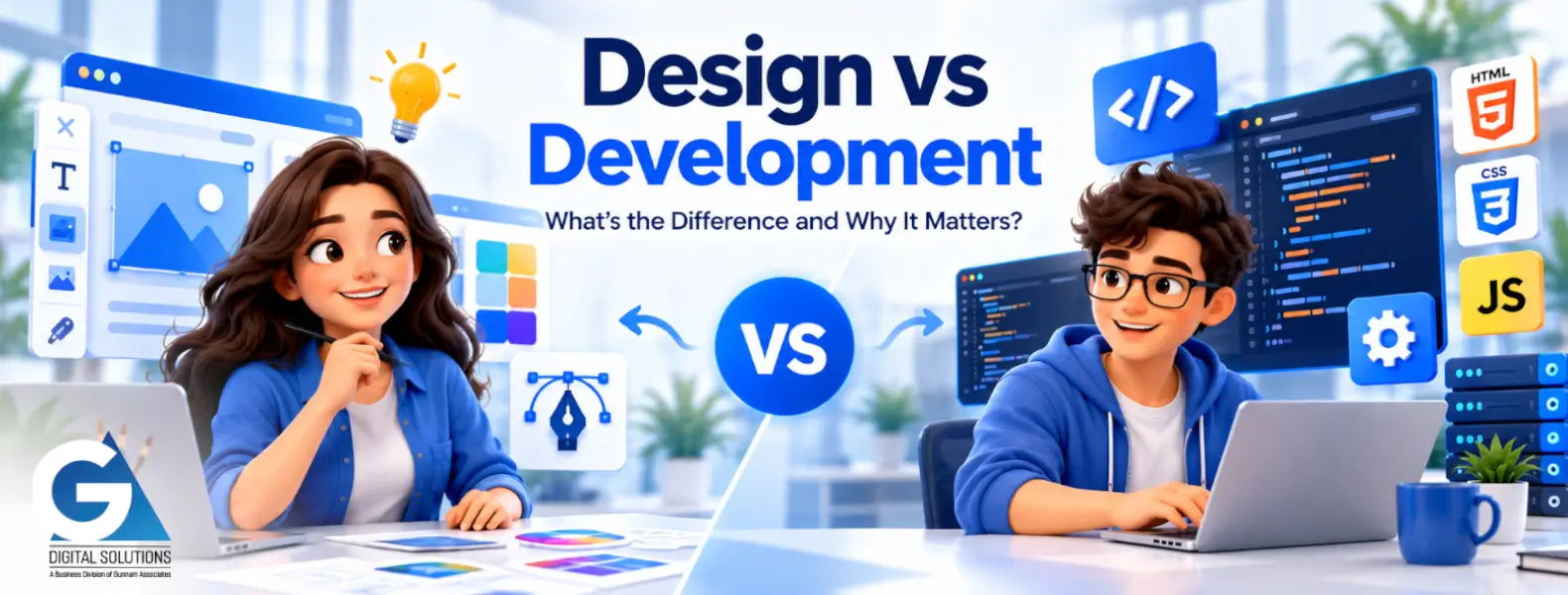
Quick answer: Website design is about how a website looks, feels, and guides the user — layout, colours, typography, and user experience. Website development is about how a website works — the code, platform, functionality, and technical performance. Design produces a visual blueprint; development turns that blueprint into a live, functioning website.
.webp)
What Is Website Design?
Website design is the process of planning and creating the visual appearance and user experience of a website. A designer thinks about how visitors will move through a page, what they will see first, how the brand should feel, and how the layout guides someone toward taking an action — like filling in a form or calling a business.
What a designer typically delivers
- Wireframes — simple layout sketches showing where each element sits on a page, before any visual styling is applied.
- Visual mockups — fully styled designs of key pages (homepage, service page, contact page) showing colours, fonts, imagery, and spacing.
- A design system — a consistent set of colours, fonts, button styles, and spacing rules applied across the whole website.
- Mobile and desktop layouts — separate designs (or responsive rules) showing how each page adapts across screen sizes.
What Is Website Development?
Website development is the process of building the actual, functioning website based on the approved design. A developer writes or configures the code that makes the website load, display correctly, respond to clicks, submit forms, and run securely on the internet.
What a developer typically delivers
- A live, functioning website — hosted, accessible by URL, and working across browsers and devices.
- CMS setup — configuration of WordPress (or another platform) so the client can update content without coding.
- Functionality — contact forms, booking systems, payment gateways, search, filters, and any other interactive features.
- Performance and security — page speed optimisation, SSL certificates, backups, and protection against common vulnerabilities.
.webp)
Side-by-Side: Design vs Development
| Website Design | Website Development |
|---|---|
| Focus: how it looks and feels | Focus: how it works and functions |
| Tools: Figma, Adobe XD, Photoshop | Tools: HTML, CSS, JavaScript, PHP, WordPress |
| Concerned with layout, colour, typography | Concerned with code, databases, integrations |
| Output: static mockups and prototypes | Output: a live, working website |
| Question answered: "Does this look right?" | Question answered: "Does this work correctly?" |
| Comes first in the project sequence | Comes after design is approved |
| Revisions are visual (colours, layout, copy) | Revisions are functional (forms, speed, features) |
Why Understanding the Difference Actually Matters
It helps you brief your project correctly
If you only talk about "look and feel" in your brief, you may end up with a beautiful design that does not have the functionality you need — like a booking system or payment gateway. If you only talk about functionality, you may end up with a working website that does not represent your brand well or guide visitors toward an action. A good brief addresses both.
It helps you understand where your money goes
Design and development require different skills, tools, and time investments. A simple design with complex custom development (like an e-commerce store with many integrations) will cost differently than a highly polished custom design built on a simple platform. Understanding which part of a quote covers which discipline helps you evaluate whether a price is reasonable for what you are asking for.
It helps you manage revisions productively
Asking a developer to "make it feel more premium" during the development phase often means going back to design — which can cause delays and additional cost. Asking a designer to "make the form actually submit to my email" is a development task, not a design one. Knowing which phase you are in helps you give the right feedback to the right person at the right time.
It helps you choose the right provider
Some freelancers and agencies are strong in one discipline and weaker in the other. A designer with limited development skills may produce a beautiful mockup that is difficult or expensive to build as designed. A developer with limited design sensibility may produce a fast, functional site that looks generic. GA Digital Solutions handles both disciplines under one roof specifically so that design decisions account for development realities from day one, and vice versa.
→ Want a website where design and development work together from day one? Get a Free Consultation
.webp)
How Design and Development Work Together in a Real Project
In a well-run website project, design and development are not two separate projects — they are sequential, connected phases of one project. Here is how that typically plays out.
1. Design comes first, grounded in development reality
Good designers working alongside developers design with technical constraints in mind from the start — they know what is realistic to build within the project’s budget and platform, so the approved design does not need to be watered down later.
2. Development follows the approved design closely
Once a design is approved, developers build the website to match it as closely as the chosen platform allows. Minor adjustments during development are normal — some visual details translate slightly differently from a static mockup to a responsive, interactive website.
3. Testing reveals where the two intersect
During testing, issues often surface at the boundary between design and development: a button that looks correct in the mockup but is too small to tap easily on mobile, or a form that functions correctly but does not match the visual style of the rest of the page. Resolving these requires both disciplines working together.
At GA Digital Solutions, the same team manages both design and development for your project — which means fewer handoff issues, faster resolution of cross-discipline questions, and a final website that looks and works the way it was intended to from the very first design draft.
Common Misconceptions
"A good designer can build the website too"
Some can — many cannot. Visual design skill and coding skill are genuinely different disciplines, and being excellent at one does not guarantee competence at the other. Always ask directly whether design and development are handled by the same person, a small team, or separate specialists — and what that means for your project timeline.
"Development is just typing in the design"
Development involves far more than recreating a visual layout in code. It includes setting up the CMS, configuring forms and integrations, optimising for speed and security, ensuring the site works across browsers and devices, and structuring the code so the website can be maintained and updated easily in future.
"We can skip design and go straight to development"
This sometimes happens with very simple template-based websites, where a pre-built design is used with minor customisation. For most business websites, skipping design means the developer is making visual and UX decisions on the fly — decisions that directly affect how well the website converts visitors into enquiries.
Frequently Asked Questions
Not necessarily. Many agencies, including GA Digital Solutions, offer both disciplines as part of a single project team. This is often more efficient than hiring separately, since the designer and developer can collaborate directly throughout the project rather than handing off a finished design with no further involvement.
It depends on the project. For a simple brochure website on a platform like WordPress, design and development costs are often comparable. For projects with complex functionality — e-commerce, booking systems, custom portals — development cost typically becomes the larger portion, since custom functionality requires significant build and testing time.
Yes, this is a common approach for budget-conscious projects. A pre-built template provides the visual design, and development work focuses on customising it with your branding, content, and any required functionality. This is faster and more affordable, though it offers less differentiation than a fully custom design. See our guide on custom websites vs templates for a full comparison.
This is possible but can affect timeline and cost, depending on how significant the change is and how much development work has already been completed based on the original design. This is why thorough review and approval of designs before development begins is one of the most important steps in a website project.
Yes. We manage the full process — design and development — under one team, which means design decisions are made with technical feasibility in mind from the outset, and development stays true to the approved design without unnecessary compromises.
Get Design and Development Working Together for Your Website
Whether you are starting a new website project or trying to understand what went wrong with a previous one, understanding how design and development fit together is the foundation for a successful outcome.
GA Digital Solutions offers a free consultation to walk through your project, explain what each phase will involve, and give you a clear, honest view of the process from start to finish.
→ Book a Free 30-Minute Website Consultation — No Obligation
Continue Reading
GA Digital Solutions is a full-service digital agency based in Hyderabad, India. We handle website design and development together — as one integrated process — for businesses across India.