




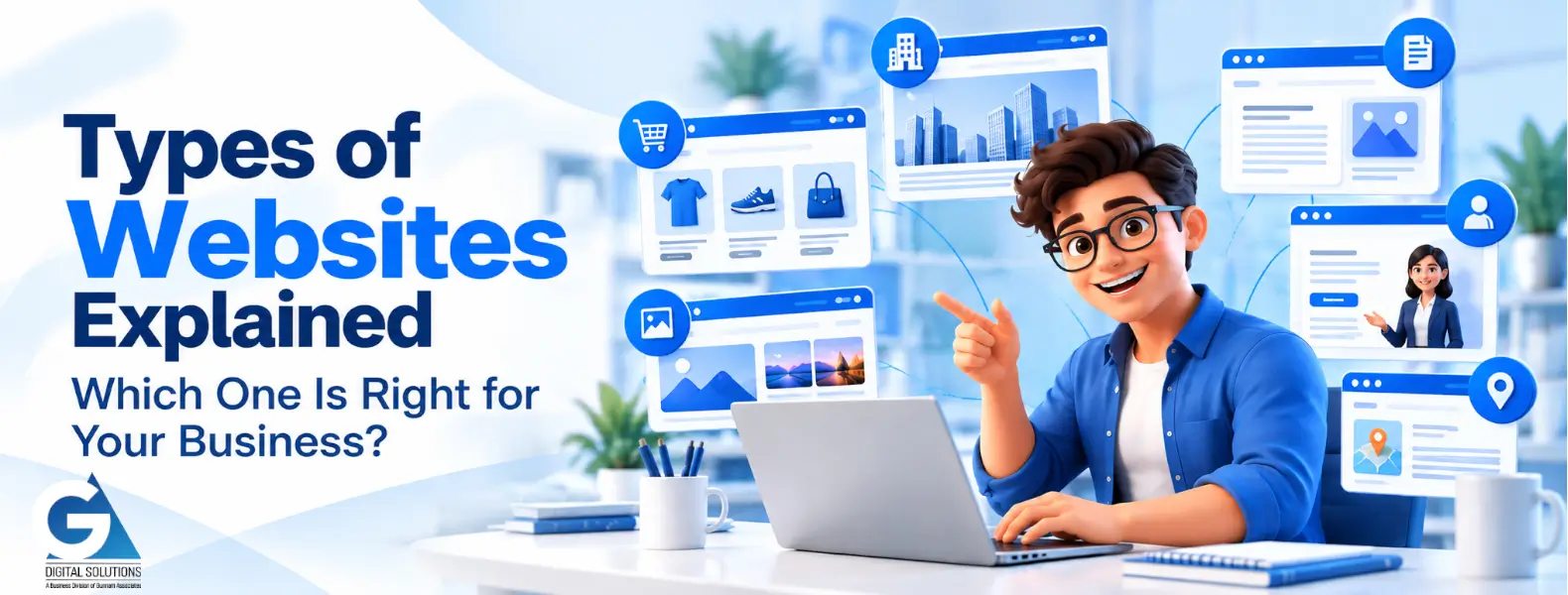
Types of Websites Explained: Which One Is Right for Your Business?
Last updated: June 2026 · 8-minute read · By GA Digital Solutions, Hyderabad
Not All Websites Are the Same
When a business owner says “I need a website,” they usually have a picture in their head. But that picture can mean very different things: a clean information page for a clinic, an online store selling products, a high-converting landing page for a real estate launch, or a custom-built portal for managing client accounts.
Each of these is a different type of website. And choosing the wrong type — even with good design and development — means building something that cannot do the job you need it to do.
This guide explains the main types of websites built for Indian businesses, what each one does well, who it suits, and how to figure out which type is right for your situation.
Quick answer: The six main types of websites for Indian businesses are: Brochure / Business Website, Lead Generation Website, E-Commerce Store, Booking & Appointment Website, Blog / Content Website, and Web Application / Portal. Most small and medium businesses need either a brochure site or a lead-gen site.
The Main Types of Business Websites
Here are the six types most relevant to Indian businesses, with a clear breakdown of what each one does and who it is for.
.webp)
01 📋 Brochure / Business Website — Professional online presence, enquiry-driven
A brochure website is the most common type for Indian service businesses. It presents who you are, what you do, the markets you serve, and how to contact you. It does not transact directly — it builds trust and converts visitors into enquiries. Pages typically include Home, About, Services, Team, and Contact.
Best For
- ✓ Professional service firms (CA, legal, consulting)
- ✓ Clinics and healthcare practices
- ✓ Coaching institutes and training centres
- ✓ Local service businesses (interior design, architecture)
- ✓ B2B companies where sales happen offline
Not The Best Fit For
- ✕ Businesses that sell products directly online
- ✕ Companies with complex workflows requiring a portal
- ✕ High-volume lead campaigns needing dedicated landing pages
Indian business examples: CA firm in Hyderabad, physiotherapy clinic in Bangalore, management consultancy in Mumbai.
02 🎯 Lead Generation Website — Built specifically to capture and convert visitor enquiries
A lead generation website goes beyond a brochure site by engineering every page around one goal: generating an enquiry. It includes dedicated landing pages, conversion-optimised forms, WhatsApp CTAs, click-to-call buttons, testimonials, and social proof placed strategically throughout the visitor journey. It is the right choice when your business runs on enquiry volume.
Best For
- ✓ Real estate developers launching new projects
- ✓ Education institutions with intake periods
- ✓ Healthcare providers wanting appointment requests
- ✓ B2B service businesses running paid search campaigns
- ✓ Any business where each lead has significant value
Not The Best Fit For
- ✕ Businesses where credibility and information matter more than conversion pressure
- ✕ Companies with very low enquiry volume (a brochure site is enough)
Indian business examples: Real estate developer in Hyderabad, MBA admissions for a private college, fertility clinic in Chennai.
03 🛒 E-Commerce Store — Sells products directly online with payment and order management
An e-commerce website enables direct product sales online. It includes a product catalogue, shopping cart, payment gateway integration (Razorpay, PayU, UPI), order management, and delivery tracking. Building a store that converts well in the Indian market requires mobile-first design, fast load times on 4G, and trust signals specific to Indian shoppers.
Best For
- ✓ Retail businesses moving from offline to online
- ✓ Product brands wanting a direct-to-consumer channel
- ✓ Artisans, handcraft sellers, and niche product makers
- ✓ Food and beverage companies doing delivery or gifting
- ✓ Businesses selling digital products (courses, downloads)
Not The Best Fit For
- ✕ Service businesses where there is nothing to add to a cart
- ✕ B2B companies where sales require negotiation and relationship
Indian business examples: Clothing brand in Surat, organic food startup in Hyderabad, handmade jewellery seller in Jaipur.
04 📅 Booking & Appointment Website — Allows customers to schedule directly without a phone call
A booking website integrates an online scheduling system with your website, letting visitors book appointments, consultations, or services in real time. It eliminates phone-tag, reduces admin workload, and improves the customer experience. For many appointment-heavy businesses, this becomes the single most valuable feature of the website.
Best For
- ✓ Medical and dental clinics
- ✓ Spas, salons, and wellness centres
- ✓ Coaching and tuition centres
- ✓ Fitness studios and personal trainers
- ✓ Legal and financial consultants with fixed session types
Not The Best Fit For
- ✕ Businesses where scheduling is complex and requires human discussion first
- ✕ E-commerce businesses where purchase intent matters more than time slots
Indian business examples: Dental clinic in Pune, yoga studio in Hyderabad, chartered accountant in Delhi.
05 📝 Blog / Content Website — Drives organic traffic through articles, guides, and resources
A content website is built primarily to generate SEO traffic through articles, guides, and educational resources. It is rarely a standalone website for a business — more often a section of a business site (like this article you are reading now). A blog builds authority, attracts top-of-funnel visitors, and supports lead generation over the long term.
Best For
- ✓ Businesses investing in long-term SEO strategy
- ✓ Brands that sell through education and trust
- ✓ Professionals building thought leadership (doctors, lawyers, educators)
- ✓ Any business where the buying journey starts with an informational search
Not The Best Fit For
- ✕ Businesses expecting short-term results from content alone
- ✕ Websites where content is an afterthought — content works only with consistent effort
Indian business examples: Digital marketing agency publishing an SEO blog, a cardiologist writing patient education content, a real estate developer explaining home-buying guides.
06 🔧 Web Application / Portal — Custom-built functionality for complex business needs
A web application goes beyond a website into custom software territory. It could be a client portal, a dashboard, a CRM, a booking engine with complex logic, or a membership platform. Development is significantly more complex and costly than a standard website, and requires clear specification of functionality before work begins.
Best For
- ✓ Businesses with unique workflows that no off-the-shelf product handles
- ✓ Companies needing client-facing portals or dashboards
- ✓ EdTech platforms and learning management systems
- ✓ Healthcare businesses needing patient record systems
- ✓ Logistics and operations-heavy businesses
Not The Best Fit For
- ✕ Businesses that have not yet established a basic web presence — start with a brochure site first
- ✕ Situations where an existing SaaS product already solves the problem
Indian business examples: Logistics company needing a shipment tracking portal, EdTech startup building a course platform, HR firm needing a candidate management system.
Quick Comparison: All Six Types at a Glance
.webp)
| Website Type | Pages | Tech Level | Timeline | Cost Range | Primary Goal |
|---|---|---|---|---|---|
| Brochure / Business | 5–15 | Low–Medium | 4–6 wks | ₹40K–₹2L | Build trust, drive enquiries |
| Lead Generation | 5–20 | Medium | 5–7 wks | ₹60K–₹3L | Maximise enquiry volume |
| E-Commerce | 20–200+ | Medium–High | 8–12 wks | ₹80K–₹5L+ | Sell products online |
| Booking & Appointment | 5–10 | Medium | 5–8 wks | ₹50K–₹2.5L | Drive bookings, reduce admin |
| Blog / Content | 1 + posts | Low | 3–4 wks | ₹25K–₹1L | Generate SEO traffic |
| Web Application | Custom | High | 12–24 wks | ₹2L–₹20L+ | Custom business functionality |
Note on costs: Figures above are indicative ranges for India. Actual project cost depends on design complexity, number of custom features, platform choice, and content requirements. GA Digital Solutions provides transparent, scope-specific quotes after a discovery call.
How to Choose the Right Website Type for Your Business
Most Indian businesses fall clearly into one or two of these categories once they answer three straightforward questions.
.webp)
Question 1: How does your business generate revenue?
If you sell products directly, you need an e-commerce store. If you sell services where the client first makes an enquiry and then you close the sale through a conversation, you need a brochure or lead-gen site. If clients need to book a session or appointment, layer on booking functionality.
Question 2: What action do you want a visitor to take?
Every website type is engineered around a primary action. Brochure site: fill in a contact form or call. Lead-gen site: submit a lead form or click WhatsApp. E-commerce: add to cart and check out. Booking site: select a time slot and confirm. If you cannot define the primary action clearly, start with a brochure site.
Question 3: What is your budget and timeline?
A brochure website is the most accessible entry point. E-commerce and web applications require significantly more investment. For most businesses starting their web presence or upgrading an outdated site, a well-built brochure or lead-gen site delivers the strongest return on investment.
Common Mistakes When Choosing a Website Type
Over-building before you have validated demand
A service business does not need a custom web application before it has 50 clients. Start with a well-structured brochure site, build your client base, and upgrade your website as the business grows.
Building a brochure site when you need a lead-gen site
If you are spending on Google Ads or Meta campaigns to drive traffic to your website, a generic brochure site is not designed for that job. Lead-gen sites and campaign landing pages have dedicated conversion architecture that a standard brochure site does not. The distinction matters significantly for ad spend efficiency.
Treating content as an optional extra
Whatever type of website you build, the content — the words, the messaging, the structure of each page — determines how well it performs. A beautifully designed lead-gen site with weak copywriting will not convert. Allocate proper resource to content alongside design and development.
The most expensive website mistake is building the wrong type well. A beautifully executed e-commerce store is worthless to a service business that generates leads through conversation. Choose the right type first, then invest in execution.
Frequently Asked Questions
Yes, and this is common. Many Indian businesses have a brochure website with an integrated booking system, or a lead-gen site with a small e-commerce section for product sales. These hybrid approaches work well — the key is knowing which function is primary and designing the site architecture around that primary purpose first.
Generally no. A well-structured service website covers all your services under one domain, with dedicated pages for each. Separate microsites are occasionally used for specific campaign launches or distinct brand offerings, but for most businesses, one strong website covering all services is the right approach.
No. A landing page is a single page built for a specific conversion goal — typically used as the destination for a paid advertising campaign. A website is a multi-page property covering your full business. Landing pages can exist independently or as part of a larger website.
For most small and medium-sized service businesses in India, a well-built brochure website (5–10 pages) with clear service pages, a mobile-friendly design, WhatsApp CTA integration, and basic local SEO is the right starting point. If the business is running paid digital advertising, upgrade the key conversion pages to lead-gen architecture.
Yes, though rebuilding is often more efficient than converting. A brochure site can be expanded into a lead-gen site by adding conversion-optimised landing pages. Adding e-commerce to an existing site is straightforward on platforms like WordPress/WooCommerce. Significant functional changes — like adding a booking system or building a client portal — are typically best handled as a planned redesign project.
Ready to Build the Right Website for Your Business?
Understanding which type of website you need is the first step. The second is working with an agency that can design and build it properly for the Indian market — mobile-first, conversion-focused, and built to support your specific business goals.
GA Digital Solutions builds all six types of websites for businesses across Hyderabad and India. We start every project with a discovery conversation to understand what your website needs to do — before any design decisions are made.
→ Book a Free 30-Minute Website Consultation — No Obligation
Related Articles
Continue Reading
- → Website Design & Development Services: The Complete Guide for Indian Businesses
- → Why Does My Business Need a Website in 2026?
- → What Makes a Good Business Website? 10 Elements That Build Trust and Convert
- → Custom Website vs Template: Which Is Right for Your Business?
- → E-Commerce Website Design in India: What It Takes to Build a Store That Sells
- → Website Design for Healthcare Businesses
GA Digital Solutions is a full-service digital agency based in Hyderabad, India. We design and develop websites for businesses across India — brochure sites, lead-gen sites, e-commerce stores, booking websites, and custom web applications.