





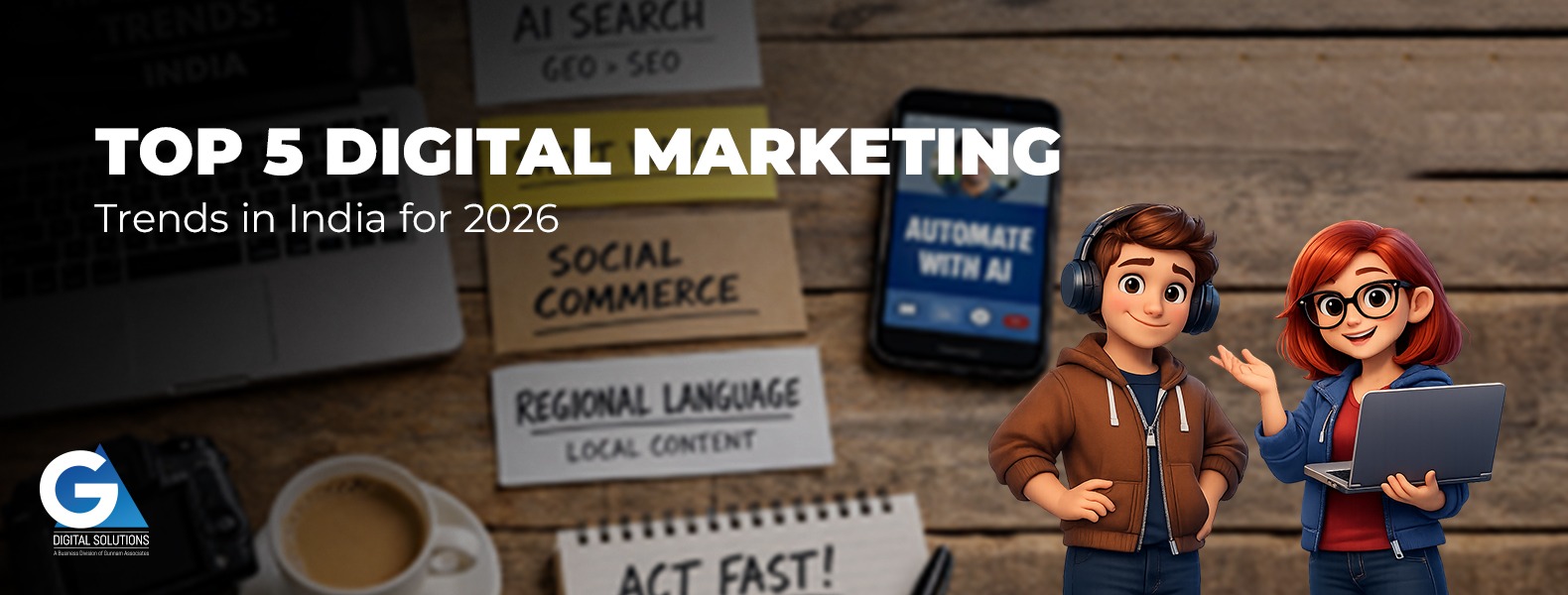
Top 5 Digital Marketing Trends in India for 2026 — And What They Mean for Your Business
India crossed 900 million internet users in 2026. Digital ad spend is projected to exceed Rs 75,000 crore by year end. And the rules of how businesses get found, trusted, and chosen online have shifted — significantly.
The tactics that worked in 2022 or even 2024 are not enough. Not because they were wrong, but because the platforms, the buyers, and the algorithms have all moved on. Indian consumers — from Mumbai to Tier 2 cities like Nashik, Coimbatore, and Bhopal — are more digitally savvy, more selective, and more likely to discover a brand on an Instagram Reel than a search results page.
Here are the 5 trends that are actually reshaping how businesses market themselves in India right now, with specific actions you can take for each.
Trend 1: AI Search Is Replacing the Old SEO Playbook
What changed: How people search, and what Google now shows them
For years, SEO in India meant backlinks, keyword density, and fighting for the top spot in Google's organic results. That playbook is getting disrupted — fast.
Google's AI-powered search (called Search Generative Experience or SGE) now synthesises answers directly on the results page, pulling from multiple sources at once. Instead of a list of 10 blue links, a user asking 'best digital marketing agency in Hyderabad' increasingly gets a generated summary — and if your business isn't cited in that summary, you may not get the click even if you rank on page one.
This shift is called Generative Engine Optimisation (GEO), and it's distinct from traditional SEO. GEO is about being trusted enough by AI systems to be referenced — not just being ranked.
60%+ of all Google searches in 2025 ended without a user clicking an organic result — AI Overviews absorbed those clicks.
What this means for your business: Audit your top 5 blog posts. Ask: does each one clearly answer a specific question, with an expert voice and original insight? If not, that's your first fix. Add an author bio, update stale data, and structure content with clear question-answer sections — these are exactly the signals GEO rewards.
Trend 2: Short-Form Video Is No Longer Optional
What changed: Content consumption in India is now mobile-first and video-first
Boring content was struggling in 2020. In 2026, it's invisible.
India has 491 million social media users, and the dominant format is short-form video — Instagram Reels, YouTube Shorts, and regional platforms like Moj and ShareChat. These platforms collectively reach audiences in Hindi, Tamil, Telugu, Kannada, Gujarati, and 12 other Indian languages at scale.
The shift from 2020's 'creative posts that add emotion' is this: authenticity now matters more than production quality. Behind-the-scenes videos, customer testimonials, how-to clips, and founder-led content consistently outperform polished brand ads on these platforms. Indian audiences, especially in Tier 2 cities, respond to faces and voices they trust — not to broadcast-style advertising.
3.5x higher engagement rate for short-form video vs. static image posts on Indian Instagram accounts in 2025, per Social Beat's benchmarks.
- You don't need a studio. A phone, decent lighting, and something genuinely useful to say is the format.
- Captions matter — a large share of Indian users watch videos on mute in public spaces.
- Trending audio is a reach multiplier. Using platform-trending sounds gets your content pushed to new audiences organically.
- Post in the language your customer speaks, not just English. A 60-second video in Telugu explaining your service will outperform an English version for audiences in Andhra Pradesh every time.
What this means for your business: Pick one platform to start — Instagram Reels if your audience is B2C, LinkedIn video if B2B. Commit to 2 short videos per week for 60 days. Track views and saves (not just likes). Save data tells you what your audience finds genuinely useful.
Trend 3: Social Commerce: From Awareness to Purchase Without Leaving the App
What changed: Indian buyers now complete purchases inside social platforms
In 2020, shoppable posts were new. In 2026, social commerce is a primary revenue channel for Indian businesses — not a nice-to-have.
Instagram, YouTube, and WhatsApp now support full purchase flows. A user can discover a product in a Reel, see reviews in the comments, and complete the purchase without ever opening a browser. Platforms like Meesho, GlowRoad, and Trell have proven this model works especially well in Tier 2 and Tier 3 markets, where trust in social recommendations is high and desktop browsing is less common.
The integration of UPI and WhatsApp Pay has removed the biggest friction point in Indian social commerce — payment. A customer who sees your product on Instagram and can pay in two taps is far more likely to convert than one who has to navigate to a website and enter card details.
India — Social commerce market projected to reach $70 billion by 2030 — growing faster than traditional e-commerce across all categories.
- If you sell products, set up an Instagram Shop and link your product catalogue directly to your Reels and posts.
- If you sell services, use WhatsApp Business to create a product catalogue listing your service packages — it acts as a lightweight brochure that customers can share.
- Live commerce (selling during a live video) is growing fast in India. Even a 30-minute live session can generate more qualified inquiries than a week of static posts.
What this means for your business: The single highest-ROI move for most Indian SMBs: set up a WhatsApp Business catalogue with 3–5 service offerings, add a 'Click to WhatsApp' button on your website and social profiles, and activate auto-reply for the first response. This one change shortens your lead response time from hours to seconds.
Trend 4: Vernacular Marketing Is Where the Real Growth Is
What changed: India's next 400 million internet users don't primarily use English
This is the trend most businesses headquartered in metros consistently underestimate.
Nearly 73% of India's internet users now consume content in regional languages. The 'Next Billion Users' — the wave of new internet users coming from Tier 2, Tier 3, and rural markets — are searching in Hindi, Marathi, Bengali, Tamil, Telugu, and Kannada. They are clicking on ads in their language. They are trusting influencers who speak like them.
Voice search is the other half of this story. With Google Assistant, Siri, and JioPhone's voice features now used widely across income brackets, search behaviour is changing from typed keywords to full conversational sentences in Indian languages. 'Best bakery shop near me' spoken in Hindi returns completely different local results than the typed English equivalent — and the businesses optimised for voice and vernacular are capturing that traffic.
Rs 4.5L Cr — Estimated size of India's vernacular content market — the opportunity for businesses that communicate in regional languages.
For voice search optimisation: convert product and service descriptions into conversational FAQ formats. Instead of targeting 'digital marketing Hyderabad', also target 'which digital marketing agency is best in Hyderabad' — that's how people actually ask the question to their phone.
For vernacular content: you don't have to produce everything in 10 languages. Start with one. If 60% of your customers are in a specific state, produce your top 5 social posts and one blog post per month in that state's dominant language. The competitive bar is low and the engagement payoff is high.
What this means for your business: Run a quick check: look at your Google Analytics data by city. If more than 30% of your visitors are from Tier 2 cities or states with a strong regional language, you are leaving significant organic reach on the table by publishing exclusively in English.
Trend 5: AI Personalisation at Scale — Even for Small Businesses
What changed: Automation tools that used to cost lakhs are now accessible to any business
In 2020, personalised marketing at scale was the exclusive domain of large enterprises with expensive CRM systems. In 2026, the tools are accessible to any business willing to learn them.
AI now handles email segmentation, WhatsApp message sequencing, retargeting ad copy generation, and customer journey automation — at a fraction of the cost of five years ago. More than half of marketers in India already use AI to automate repetitive marketing tasks, freeing up time for the strategic work that actually requires human judgment.
The Indian buyer's path to purchase is non-linear. A customer might see your Instagram ad, ask for reviews in a WhatsApp group, Google your business name, and finally call you — all before converting. AI tools help businesses stay present and consistent across that entire journey without requiring a dedicated team for each channel.
45% — Speed improvement in creative workflow optimisation reported by agencies using AI-enabled media and content analysis tools.
- Start with email or WhatsApp automation — a 3-message welcome sequence for new leads costs nothing to set up and significantly improves conversion rates.
- Use AI tools for content ideation and first drafts, then add human expertise and your own examples before publishing. AI-generated content without a human layer increasingly gets filtered out by Google.
- Set up Google Analytics 4 properly and review it weekly. The businesses winning in 2026 are making decisions based on real engagement data — not guesses.
- Retargeting is underused by Indian SMBs. If someone visited your website but didn't contact you, a well-crafted retargeting ad on Instagram or Google can bring them back for a fraction of what a new acquisition costs.
What this means for your business: Pick one automation to implement this month. A WhatsApp Business auto-reply + a 2-message follow-up sequence is a 2-hour setup that can immediately improve how quickly you respond to leads — and speed of response is one of the biggest determinants of whether a lead converts or goes to a competitor.
The Bottom Line
The businesses that grow in 2026 won't necessarily be the ones with the biggest budgets. They'll be the ones that understand their audience, show up in the formats their customers actually use, and adapt faster than the competition.
India's digital market is unique — multilingual, mobile-first, trust-driven, and increasingly driven by conversational search and short-form video. The global trends matter, but the India-specific layers are what separate businesses that grow from businesses that stagnate.
You don't have to implement all five trends at once. Pick the one that maps most directly to where your customers actually spend their time, execute it well for 60 days, then stack the next one on top.
Ready to Build Your Business with These Trends?
GA Digital Solutions helps businesses in Hyderabad and across India implement these exact strategies — from AI-ready content and local SEO to WhatsApp marketing and social commerce campaigns.
👉 Start Building Your Business with GA Digital — gadigitalsolutions.com