






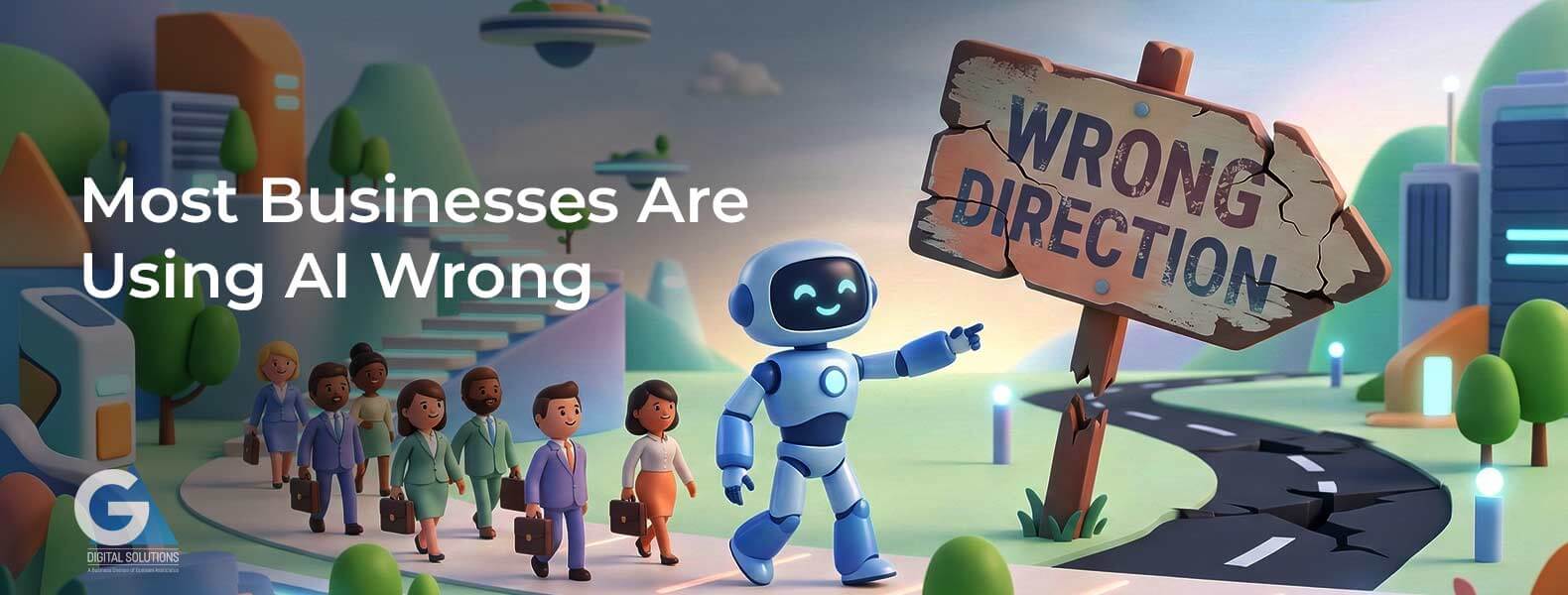
Most Businesses Are Using AI Wrong. Here’s What Smart Digital Strategies Do Differently
Artificial Intelligence has triggered two extreme reactions in the business world.
Excitement and anxiety.
Some businesses see AI as a revolutionary advantage.
Others treat it as a looming disruption.
But beneath both reactions lies a deeper reality.
AI alone is not the competitive advantage.
How intelligently it is embedded into digital solutions is.
While some companies are unlocking efficiency, clarity, and scalable growth — many others are simply accelerating noise, confusion, and misaligned execution.
AI is not being used incorrectly because the technology is flawed.
It is being used incorrectly because strategy is missing.
AI Is Not a Department — It’s an Intelligence Layer
One of the biggest misconceptions businesses have is treating AI as a separate initiative.
In reality, AI delivers the most value when it becomes an intelligence layer across the entire digital ecosystem.
It should enhance:
- Decision-making
- Workflow efficiency
- Customer experience
- Content systems
- Operational processes
Businesses gaining real advantage are not “using AI occasionally."
They are redesigning digital systems with intelligence built in.
Understanding the Evolution: Tools, Bots, and Agentic AI
Not all AI works the same way.
To use it strategically, businesses must understand the three levels of AI sophistication.
1. AI Tools — Task-Based Assistants
AI tools are the most common and widely used form of AI.
They help perform specific tasks such as:
- Generating text
- Creating visuals
- Analysing data
- Assisting with research
- Supporting workflows
AI tools are passive.
They wait for instructions.
They respond to prompts.
They execute specific commands.
They improve productivity and speed.
But they do not operate independently.
They do not set goals.
They do not design strategy.
Most businesses today operate primarily at this level.
And this is where many misunderstand the true potential of AI.
2. AI Bots — Reactive Digital Assistants
Self-service is the fastest-growing form of customer support. Customers prefer to solve problems themselves if the right information is easily accessible.
A well-designed knowledge base includes:
- Help articles
- Step-by-step guides
- Tutorials
- Troubleshooting instructions
- FAQs
When optimized effectively, it becomes your digital support library—always active, always available, and always accurate.
For many businesses, this single step reduces support tickets by 20–40%.
3. Agentic AI — Autonomous Intelligence Systems
This is where the real shift begins.
Agentic AI systems move beyond responding.
They can:
- Set goals
- Plan multi-step actions
- Make contextual decisions
- Use other tools
- Adapt based on outcomes
- Optimise processes over time
Agentic AI is proactive.
Instead of waiting for instructions, it analyses objectives and determines execution pathways.
This transforms AI from assistance into operational intelligence.
It does not just complete tasks.
It orchestrates them.
This is where digital transformation becomes real.
Why This Difference Matters
Most businesses are still operating at the AI tool level.
A few are experimenting with bots.
Very few are designing intelligent systems.
And that is the competitive gap.
- AI tools improve execution.
- AI bots improve interaction.
- Agentic AI improves systems.
Competitive advantage no longer comes from “having AI.”
It comes from how intelligently AI is layered into digital infrastructure.
AI Will Not Replace Humans — But It Will Redefine Value
There is still fear around replacement.
But the reality is different.
AI replaces:
- Repetitive manual work
- Mechanical processing
- Low-value routine tasks
AI enhances:
- Analysis
- Creativity
- Strategic planning
- Decision support
Human value shifts upward.
- Toward interpretation
- Toward empathy
- Toward innovation
- Toward strategic judgment
The future is not AI vs humans.
It is AI + Human Intelligence.
The businesses that understand this shift will redesign roles, not eliminate them.
The Real Competitive Advantage of AI in Digital Solutions
Artificial Intelligence is not the digital advantage.
Intelligent digital solutions are.
AI does not automatically create growth, efficiency, or impact.
It amplifies whatever system it enters.
- Clarity or confusion
- Efficiency or inefficiency
- Strategy or randomness
When integrated with structure, AI strengthens digital ecosystems.
When applied without direction, it simply accelerates noise.
The real divide is not between businesses that use AI and those that don’t.
It is between businesses that use AI intentionally — and those that use it reactively.
Because technology is never the differentiator. Strategy is.
How GA Digital Solutions Builds AI-Integrated Digital Systems
At GA Digital Solutions, AI is not treated as a trend.
It is embedded thoughtfully across digital strategies, marketing systems, content ecosystems, development workflows, and operational intelligence.
Always aligned with measurable outcomes.
Never driven by tool obsession.
The goal is not to “use AI more.”
The goal is to design digital solutions that think, adapt, and scale intelligently.
Is your AI integration creating real digital advantage — or simply accelerating activity?
👉 Book a Strategy Consultation with GA Digital Solutions
👉 Request a Digital & AI Growth Assessment
Because AI delivers impact only when aligned with intelligent systems and expert thinking.